Most people don't know that royalties are usually paid to authors quarterly. It's an old tradition that started with good reason.
In the day of the brick and mortar bookstore (of which, thankfully, some still exist), publishers printed books and sent them to the stores. The stores reported the sales and paid for the books after they were sold. Publishers paid writers for the copies that sold. The reporting process was done by mail. Electronic reporting didn't exist then. It generally took a couple of months for money and sales figures to sort themselves out.
As a result, authors got paid quarterly. They still do. We still do, in most cases. There's no reason it has to be that way anymore. Electronic transfer of funds is the standard practice now. Publishers aren't going to change this method, however, because it works to their advantage and they hold the cards. I really don't fault them for that.
Don't get me wrong... I'm less than thrilled with the setup, but there's not much I can do about it.
Amazon pays monthly. That's what they say, and that's what they do. Barnes and Noble does the same thing. I'm speaking about Kindle and Nook respectively. It amounts to almost the same thing--and here's how: Both Amazon and Barnes and Noble pay 60 days after the month in which the sale occurs. In other words, they pay the writer monthly...up to three months after the reader purchases the book. The only difference with those two is that there is a monthly income.
I'm okay with the above, mostly because it would be pointless not to be okay with it. I just budged to get paid on a quarterly basis. If all goes well and the income rises to the point where royalties become my main source of income, I'll get smarter about it.
The bite comes when my books get sold through one company that pays quarterly to another company that pays quarterly. iTunes falls into that category for me, and so does Amazon for my books in print. If someone buys one of my books from iTunes in January... iTunes will report the sale at the end of March. The company that sold the book to iTunes will report that January sale to me, which was reported to them at the end of March...at the end of June. I'll get my money six months after the reader spends it.
I'm not bitching about that, by the way. I'm writing this so new authors can plan accordingly, and so I have it clear in my head.
To readers: keep buying books, electronic or paper, from wherever you're comfortable buying them, and buy them in whatever format suits your needs and desires. I'm just happy there are people out there buying books and reading them.
Without readers, writers are just people with nimble fingers and minds...
Wednesday, February 8, 2012


Sunday, February 5, 2012
Tonight I'm going to read the Super Bowl
Read the Super Bowl?
I'm not into sports. I don't have anything against them. I just don't care. What I like are people's reactions to the minutia of the game.
Have you ever had Facebook open during a big sporting event? If you have a lot of Facebook friends that are into sports, it can be a real treat to read the game.
The news feed will be filled with little comments from fans of both teams. Just by keeping one eye on the feed and one eye on CBS (which isn't airing the Big Game), I'll have a pretty good idea of what's going on between whichever teams are crashing into each other on the field. I'll know which commercials to look up on YouTube.
If Madonna does anything nasty during the halftime show...I'll know. And when I know, I'll be able to find it on YouTube within a minute or two whether or not the network censors let it through.
It'll be entertaining.
I'm not into sports. I don't have anything against them. I just don't care. What I like are people's reactions to the minutia of the game.
Have you ever had Facebook open during a big sporting event? If you have a lot of Facebook friends that are into sports, it can be a real treat to read the game.
The news feed will be filled with little comments from fans of both teams. Just by keeping one eye on the feed and one eye on CBS (which isn't airing the Big Game), I'll have a pretty good idea of what's going on between whichever teams are crashing into each other on the field. I'll know which commercials to look up on YouTube.
If Madonna does anything nasty during the halftime show...I'll know. And when I know, I'll be able to find it on YouTube within a minute or two whether or not the network censors let it through.
It'll be entertaining.
Tuesday, January 31, 2012
Strange leads from Indonesia...
I don't want to know why my blog got three hits from a site called "whoresex" today. There's nothing on this blog that would indicate I'm offering anything for sale that might interest someone interested in finding what I would guess they were seeking...unless they plan to read a good fantasy novel to someone they're paying. If that's the case, I don't want to know that either.
In fact, I think I'm probably better off if I just keep doing what it was I was doing before I decided to take a break and see if anyone has looked at this blog today. I'll go back to work on Sexton Retribution and let those happy seekers read to those they're paying.
Pardon me if I snicker a bit while I do it.
In fact, I think I'm probably better off if I just keep doing what it was I was doing before I decided to take a break and see if anyone has looked at this blog today. I'll go back to work on Sexton Retribution and let those happy seekers read to those they're paying.
Pardon me if I snicker a bit while I do it.
Tuesday, January 17, 2012
Long range goals, and the making of a quilt.
 |
| Each square is 1" x 1" finished size |
It started on a lark, the quilt I call Pegasus. My wife likes to cross-stitch and I like some of the patterns. I saw one of a knight riding a Pegasus and I liked the pattern. I'm a quilter. I like long projects. I'm also a novelist, and there are similarities between quilting and writing a novel. Both are big projects, and both require commitment.
A cross-stitch pattern, as you probably know, is made up of symbols on squares. Each symbol represents a color of floss (thick thread used in cross-stitch projects), and tells the person specifically which color floss to use.
 |
| Two pink squares, out of 7,544 total squares |
I wanted to turn the pattern into a quilt. There aren't any directions for that sort of thing that I could find, so I had to wing it. I took the pattern to the local JoAnn's Fabric store along with a floss sample thingy (a highly technical term for a card that had little pieces of floss of every kind the manufacturer made) and went up and down the aisles of bolts of fabrics looking for shades and patterns for my quilt.
The cross-stitch pattern had a lot of shades of gray, but I only used four or five in the quilt. After an hour or so in the fabric store, and having to use a shopping cart to carry all the bolts of cloth, I made my way to the cutting table. I'm used to getting strange looks in fabric stores, as I've explained elsewhere on this blog. They looked at me like I was nuts when I asked them to cut different sizes from each fabric. I don't think I told them what I was planning. Keeping them guessing was half the fun, and I didn't want to prove I was nuts by explaining my plan.
The next step was cutting the fabric into squares 1.5" on a side. I needed the extra quarter inch around each square for seam allowances--that bit of fabric on either side of the seam (explaining for those who don't sew.) I used a rotary cutter, which is a device that looks like a pizza cutter but with a razor sharp blade that will cut through several layers of fabric at once. I cut thousands of squares, and held them together in little piles by running a strand of thread through the stack of squares, like stringing popcorn.
I made a grid of 10 squares by 10 squares on a piece of paper and made a hundred photo copies. Using the pattern and having translated the symbols for floss colors to my own shorthand, I made my own pattern.
It was finally time to start sewing the squares. I took my 10x10 square paper pattern and sewed squares to match. My big project became a series, a long series, of one hundred square blocks. Many of those blocks were 100 black squares, or black squares with a few gray squares, or...well, you get the idea.
 |
| Variations of light make the quilt pop. |
When I finished enough 100 square blocks to make a row of the quilt top, I stitched the blocks together to make a row.
You might be wondering by now how long the quilt took me to make. Three years is the answer. It was a pleasure watching the squares grow into rows and the rows start (slowly!) to reveal the larger pattern. I had started at the bottom, so over time I was able to see the long stretches of black squares become black squares with legs, then a massive white-gray-white-gray body, then the head build. I looked forward to the gold of the rider's armor. The quilt top became my quiet obsession.
 |
| The fabric in the armor looks like chain mail. |
Finally the top was done! I went back to JoAnn's and bought a dark batt--the innards of the quilt. Most quilt batts are white, but I was using dark fabrics, and didn't want the white of the quilt batt to shine through the dark fabrics. I couldn't find black fabric wide enough to make the quilt back from one piece, so I bought a couple of yards of magenta fabric and made a wide stripe of magenta down the middle of the black back.
Then...how to quilt it? Quilting is what makes a quilt a quilt. It's the stitching, sometimes decorative, that holds the three layers together.
I didn't want the quilting to be obvious. After all that work, I wanted the overall design to be the highlight of the project. I used black thread and stitched inside the seams on every square that made up the Pegasus's body, the wings, the knight, the lance, the head, etc. I quilted black X's across the black squares.
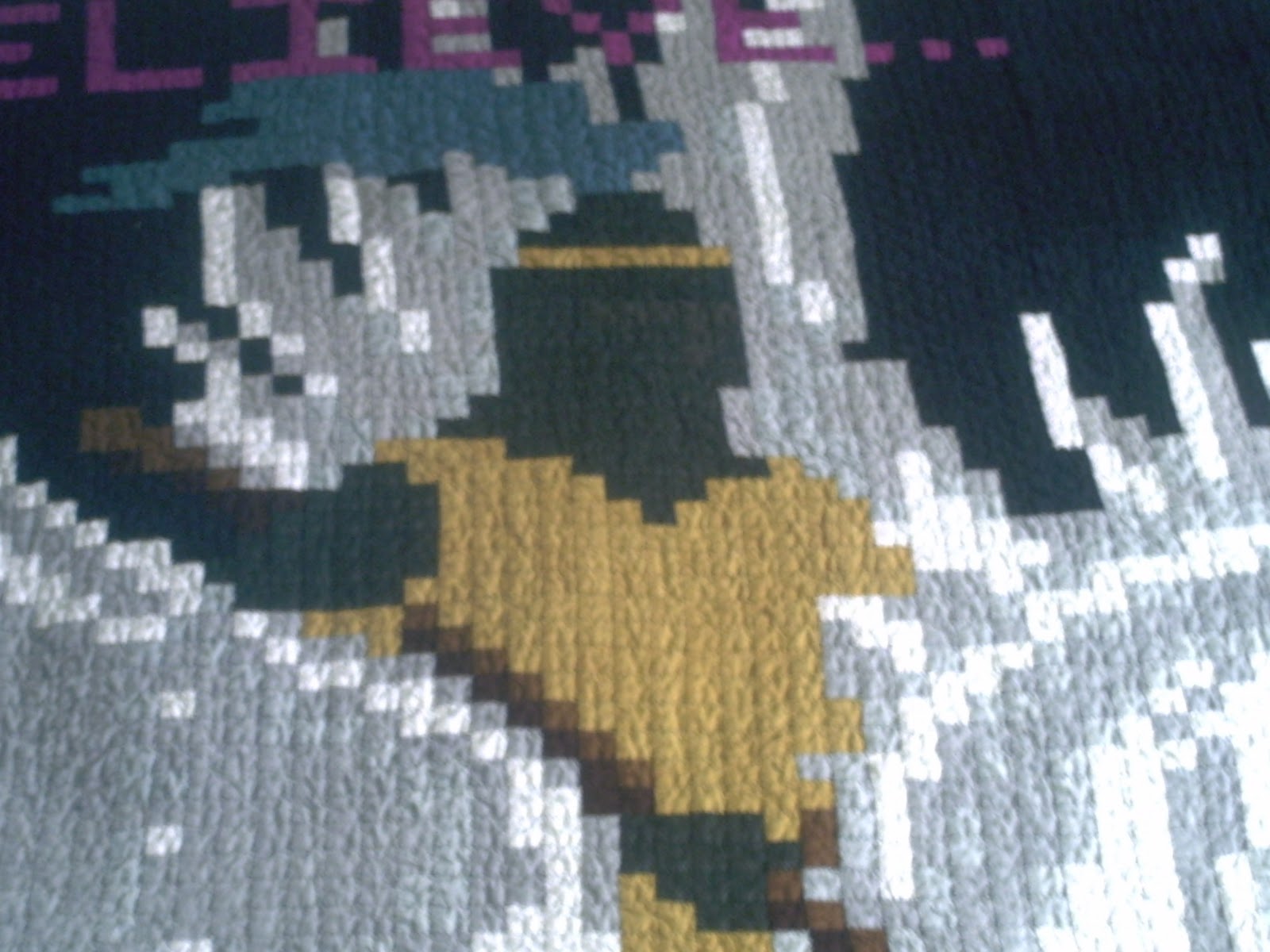
 I'm pretty sure this quilt is a one of a kind. That's one of the many things I like about it. It's warm too, as you might guess. We use it sometimes.
Friday, January 13, 2012
Thank you Reader, for making my day! (It was better than giving my first autograph.)
I dreamed about having books out there in the wide-world for people to buy and read a long time before I published Sexton a couple of years ago. In one of those many, many daydreams (okay, more than one, but who's counting?), I wondered how it would feel to hear someone talk about my books when they didn't know I was listening.
Yesterday I found out. It was great!
I loaned a copy of Sexton to a friend of mine at work, and she put it on a table on the other side of the room. The table she put the book on is next to another room, a room I couldn't see in from where I was standing.
A female voice I didn't recognize came from the other room. She said, "Are you reading Sexton?"
My friend looked at me, then back into the room at the person I couldn't see. "Have you heard of it?"
"Yes. I've read all of them!"
My eyebrows shot up. I'll confess I got a little suspicious. I thought I knew all of the people at work who have read my books, but I didn't know the person in the room. I was sure of it. I'm good at recognizing voices, and hers was new to me.
"All of them?" my friend asked.
"It's a series."
"Oh! I didn't know that. They're sci-fi, right?"
"Fantasy. ...Good adventure, and they're funny too."
I walked toward the room. I wanted to see who my unknown fan was. My friend introduced us, and I was delighted. If you're an author and this hasn't happened to you yet, I hope it happens soon. It's terrific to hear someone talk about your work, and then getting to meet them. I suppose it's a different kind of terrific if they hate your work and bash it when you're in earshot, but even that ain't all bad. You might learn something you wouldn't learn otherwise.
Still, I'm glad she likes Sexton Chronicles.
Yesterday I found out. It was great!
I loaned a copy of Sexton to a friend of mine at work, and she put it on a table on the other side of the room. The table she put the book on is next to another room, a room I couldn't see in from where I was standing.
A female voice I didn't recognize came from the other room. She said, "Are you reading Sexton?"
My friend looked at me, then back into the room at the person I couldn't see. "Have you heard of it?"
"Yes. I've read all of them!"
My eyebrows shot up. I'll confess I got a little suspicious. I thought I knew all of the people at work who have read my books, but I didn't know the person in the room. I was sure of it. I'm good at recognizing voices, and hers was new to me.
"All of them?" my friend asked.
"It's a series."
"Oh! I didn't know that. They're sci-fi, right?"
"Fantasy. ...Good adventure, and they're funny too."
I walked toward the room. I wanted to see who my unknown fan was. My friend introduced us, and I was delighted. If you're an author and this hasn't happened to you yet, I hope it happens soon. It's terrific to hear someone talk about your work, and then getting to meet them. I suppose it's a different kind of terrific if they hate your work and bash it when you're in earshot, but even that ain't all bad. You might learn something you wouldn't learn otherwise.
Still, I'm glad she likes Sexton Chronicles.
Friday, January 6, 2012
A Lone Man at a Quilt Shop...Spooks the Natives
I walked into a fabric store this afternoon. I was by myself. The place was quiet when I walked in, and suddenly got quieter when the owner and three older ladies spied a man by himself in the doorway.
Usually, when a man darkens the doorway of a fabric store, he's being towed by his wife. He is expected to stand around with his hands in his pockets, inspecting the top of his shoes, and replaying a Lakers game in his head while he prays for the ceiling to collapse around him so he'll have an excuse to go out to the car and stick his head in the glove compartment. The natives of a quilt store expect this behavior of a man in their natural habitat and, although they might feel his pain, they also feel it makes up for the looks they get when they have to sit around a car dealership waiting to have their oil changed.
Not me. I'm quite comfortable in fabric stores. I go in alone to freak out the natives.
They eyeball you, those denizens of Ye Olde Quilt Shoppe. They eyeball the man the way one might eyeball a confused pink elephant that wanders into one's living room.
I wandered up and down the aisles of fabric on the bolt, pulling one or two and comparing them to each other in the natural light from the windows. One of the ladies came up and asked if she could help me. I smiled and said, "No thanks." I heard her whisper to the two ladies at the cutting counter when she walked away.
I pulled a couple of bolts from the shelf and held them under one arm. Walked to a different aisle to look at the brown fabrics. Looked at the ends of the bolts to see fabric content--which was a bit of a show, really. I can feel fabric content with my fingertips. Amateurs read labels to see if there's polyester in the fabric.
I took my sweet time choosing the fabrics I want to work with. It's a bit of a different color scheme I'm working on. I'm making this quilt as a gift for a friend of mine who just became a Dad. He has a little girl, and they decorated the baby's room in a combination of pink, brown, and white. The room is beautiful, and the colors play well together. I was enjoying putting fabrics together in that color scheme...but it wasn't easy. There aren't a lot of pink and brown prints out there.
By the time I wandered up to the cutting table, after taking my sweet time (all 8 minutes of it), the ladies stepped back except for the one who was going to cut the fabric. I have noticed over the years I've spent buying fabric that employees put men in fabric shops in two categories: a) lost, bored, pitiable husband, or b) crafting expert who knows-his-stuff-better-than-most or he wouldn't be there at all.
The polite smiles and offers of assistance changed when I put the bolts on the table and waited my turn. Tentative, almost timid questions and comments came:
"What are you making?"
"My...what wonderful colors those are together!"
"I wouldn't have thought to do that...but wow, that looks great!"
"How many quilts have you made?"
I'll confess I love those moments. I'll post photos when I'm done.
Sunday, January 1, 2012
Thoughts about this new year
Some people like to make new year's resolutions. I'm not one of them. Resolution is a strong word. It's something that someone resolves. I like goals. I've lived with goals most of my life, and I'm happy to say I've achieved many of them over the course of the years.
I haven't decided what my personal goals are for 2012, and I think that's okay. The year isn't very old yet. It's just begun. I can tell you my personal goals include finishing Sexton Retribution and publishing it. One goal is to write at least the first novel in a new series.
That new series will be about an American by the name of Nick Galizzi. If you've read Sexton Sand, you know who Nick is. He's an American, and he's a wizard. The new series will be fantasy, but it'll be set in this world. Nick can move around in time in ways most men can't, and I think he's going to have dealings with the most prolific serial killer in the history of this country, and evil man by the name of Herman Mudget who used the alias H. H. Holmes.
I also intend to do more to try to increase awareness of Wernicke-Korsakoff disease. The more I learn about it, the more I believe that recovery is possible. It's not easy to recover from that one, but it can be done. Read Green Goblin or Blackout: a Look Inside Wernickes (linked on this page) to find out more about that.
I'm sure other things to do and try will come up during this new year. I don't know what they are yet, of course, but I'm comfortable in my ability to face them without hiding under the bed too much.
Happy new year, my friends!
Friday, December 30, 2011
Answering questions the fun way...
Sometimes I get in an impish mood (okay--pretty much most of the time).
It's fun to answer someone's question, and only the question they ask--not the one they meant to ask.
For example:
When someone I don't know calls me on the phone and says, "Is Dave there?"
I say, "Yes."
Then I hang up the phone.
Tonight someone said, "Could you give these people directions to the hotel?"
I said, "Sure! I could..."
The other day a lady asked me: "Do you know where the bathrooms are?'
"Yes, ma'am. I do."
I'm small, but I know when to run!
It's fun to answer someone's question, and only the question they ask--not the one they meant to ask.
For example:
When someone I don't know calls me on the phone and says, "Is Dave there?"
I say, "Yes."
Then I hang up the phone.
Tonight someone said, "Could you give these people directions to the hotel?"
I said, "Sure! I could..."
The other day a lady asked me: "Do you know where the bathrooms are?'
"Yes, ma'am. I do."
I'm small, but I know when to run!
Monday, December 26, 2011
Quilt Completed! We'll enjoy it for years.
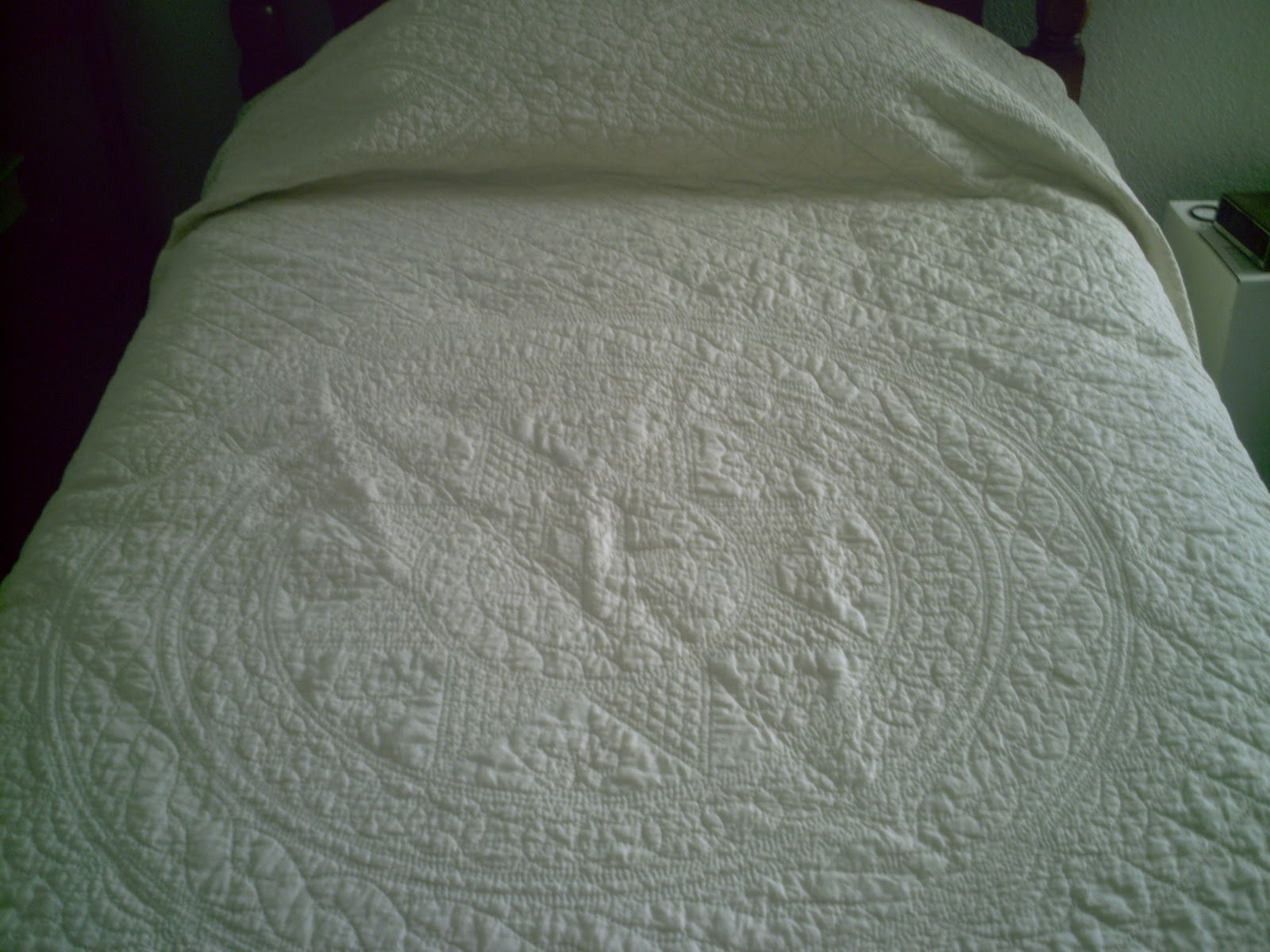
I started making quilts years ago, after getting bored at my mother-in-law's house. My mother-in-law taught me some of the basics of quilting, and I put the lessons to use shortly after that.
 This quilt is made from one big hunk of fabric, and the lines you see are created by small stitches. A good quilter makes small, even stitches. I'm pleased to say I manage 7-8 stitches to the inch, and they're uniform in size. Most quilters will tell you that even stitches are the goal and that the number per inch doesn't matter much. I'd agree, but only in part. I like the way small stitches make the detail "pop."
Every line on this quilt is made by hand-stitching. My hands hurt a bit from all the stitching. A month and a half ago I got the idea that I would finish this quilt in time for Christmas. I did, but it involved a Herculean effort of 4-6 hours a day of stitching by hand. I used sports cream when my hands got sore, and it'll be a while before I can shake hands without pain.
It was worth the effort when she opened it and we put it on our bed.
Here's the story behind the quilt:
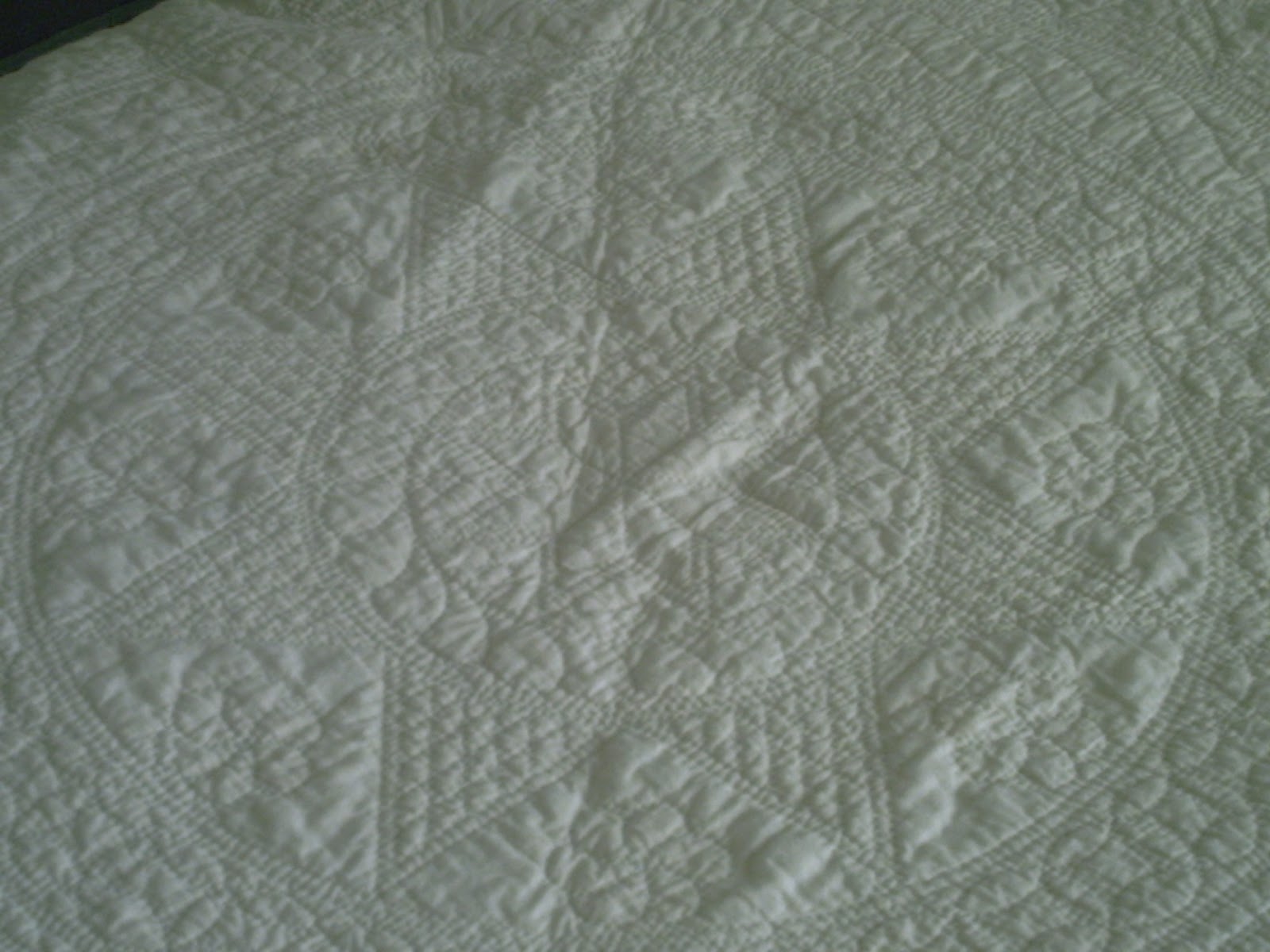 When I took a job in Cleveland in 2003, my wife stayed behind in Wisconsin to finish out the school year. She's a teacher and we always said that if we moved during a school year, she would stay behind to finish it. I admire that, and that's what we did when I moved to Cleveland. I lived alone in a one-bedroom apartment for a couple of months, and I got bored. I ordered a kit that included a top with blue lines (they washed out) and was intimidated when I saw how many blue lines I would have to quilt over to make this thing. I started it, got the center medallion done, and shoved it in a closed after my wife joined me.
 I got sick in 2005, and if you've read much in this blog, you already know I was sick with Wernicke Encephalopathy. I recovered, which is a story of it's own. I used to drink while I was quilting, and I wasn't sure I would ever be able to quilt again. I was afraid I'd want to drink when I quilted. I was afraid I wouldn't be able to quilt as well sober as I did when I was drinking. Seriously! I have hand tremors. Drinking steadied my hands until sobriety slipped into drunkenness.
 When I was trying to decide what to give my wife for Christmas this year, I pulled the quilt out of the closet, looked at it and thought, "I have the middle done. Won't take much time to do that last four feet around."
I should've known better. This isn't my first quilt. It's my fifteenth or sixteenth quilt. The center of the quilt is the easiest part--the smallest hunk. Each time around the center gets exponentially bigger, as anyone better than me at geometry can tell you. That's just about anyone, by the way. I'm a mathemagical moron.
Dogged determination is how one makes a big quilt when the only design is created by stitching. Quilting, (to steal a phrase and warp it a bit) is 10% skill and 90% persistence. I think I almost made up for the years it sat in a closet by finishing this thing in 6 weeks.
Sunday, December 18, 2011
A serious car accident, and we were able to help along with a lot of good people
It's a dark night tonight with no moon, icy roads, and a thin sheen of snow on the roads her in Michigan.
My wife and I were on our way home, driving North on I-75 through Flint, MI. I was at the wheel, and the road conditions had me driving well under the speed limit. My wife was sleeping in the passenger seat.
There are four lanes of traffic on that part of I-75. There was an accident. I saw two cars on the right side of the road, one on the shoulder, and pulled over to the far left lane. I was looking at the wreckage to see if others had stopped and if anyone was calling for assistance. There were other cars stopped, so I decided to keep moving rather than risk blocking traffic. I think I was moving at about 20 mph at that point.
On my right another car barreled by. I don't know how fast that driver was going. I can tell you she didn't hit the brakes.
She rammed one of the cars on the right, about twenty feet in front of our car. Sparks flew. It was horrific. I parked our car, no longer questioning whether or not we should stop. My wife woke up and I said, "There's been a bad accident and we're stopping to help." She agreed immediately.
I got out of the car and started walking toward the vehicle that was hit. It was now on my left, on its wheels, but sideways across the lanes. As I approached it, I saw a man bent over something in the road.
The something wasn't a thing at all, it was a someone. His girlfriend, as it turned out. She was lying facedown on the pavement.
I had a sinking feeling that she was dead. How could she not be?
She's not dead. I thought traffic was still coming at us, so I looked at the other man and said, "Let's get her out of the road before someone hits her."
We touched her and a woman behind me said, "Do not move her!" I didn't argue with her. I looked at the oncoming traffic and saw that my wife and another man--bravely--had stopped all other traffic. Several others were already on cell phones, speaking to 911 operators.
My wife (who has better and more up-to-date first aid training than I do) was at the woman's side, on the ground in the middle of I-75, along with several others. I went to the car that had been hit and flung, and looked inside to see if there were any other victims. The car was empty.
Then I went to the car that hit that one. The driver was a young woman, maybe 20-25 years old. She was shaken. A man had just finished speaking to her and he passed by me and said, "She thinks she killed that lady in the road. I told her she didn't."
The driver of that car, that young woman, was hysterical. I got her to calm down enough to be able to tell me if she was okay or not. She got the message that she hadn't killed anyone, and wanted to know about damage to her car. I don't blame her much for that. She was desperately trying to wrap her brain around something, anything, and she settled on asking about her car.
I took a look at the hood and said, "Your car is totaled, but I want you to look out the windshield at the woman on the ground. She's not dead, but she's not okay. Your car? It's the least of your worries. Are you okay? Are you hurt?"
"I'm okay."
"She's not dead. Breathe. Stay here. Don't get out of the car until EMT's check you out. Got it?"
She did.
Fortunately (and by that I mean the Hand of God was all over the place and quite present tonight), the accidents happened not far from a Michigan State Police post. Within just a few minutes, ambulances and police were on their way.
According to the boyfriend of the woman in the road, they were involved in an accident, and he got out of the car to check on the other driver. His girlfriend was driving their car, and she was about to get out and offer assistance as well. She unfastened her seatbelt...his door, the passenger door was open...
I went back to the woman in the road, and a man was saying a prayer of thanks over her, and I thought that was appropriate and a good thing to do. He said he's a doctor, and that she's lucky. He couldn't check her out thoroughly, but said her arm was broken and her shoulder was dislocated, but she wasn't paralyzed. I knew she wasn't paralyzed because I put a blanket over her feet (her shoes flew off when she was thrown from the car), and she moved her legs when I did that. Others had already covered her with coats and blankets from their cars.
It was about an hour between when we came upon the accident and when we were turned around and allowed to proceed, slowly, home.
I'll probably never know the names of anyone involved in that terrible thing, but I know this: there are a lot of good people on this beautiful world of ours. We all make mistakes and accidents happen, but it helps a little to know that there are a lot of good people who will do a lot, risk a lot, to help their fellow human beings when they're in trouble.
Merry Christmas! Drive safely.
My wife and I were on our way home, driving North on I-75 through Flint, MI. I was at the wheel, and the road conditions had me driving well under the speed limit. My wife was sleeping in the passenger seat.
There are four lanes of traffic on that part of I-75. There was an accident. I saw two cars on the right side of the road, one on the shoulder, and pulled over to the far left lane. I was looking at the wreckage to see if others had stopped and if anyone was calling for assistance. There were other cars stopped, so I decided to keep moving rather than risk blocking traffic. I think I was moving at about 20 mph at that point.
On my right another car barreled by. I don't know how fast that driver was going. I can tell you she didn't hit the brakes.
She rammed one of the cars on the right, about twenty feet in front of our car. Sparks flew. It was horrific. I parked our car, no longer questioning whether or not we should stop. My wife woke up and I said, "There's been a bad accident and we're stopping to help." She agreed immediately.
I got out of the car and started walking toward the vehicle that was hit. It was now on my left, on its wheels, but sideways across the lanes. As I approached it, I saw a man bent over something in the road.
The something wasn't a thing at all, it was a someone. His girlfriend, as it turned out. She was lying facedown on the pavement.
I had a sinking feeling that she was dead. How could she not be?
She's not dead. I thought traffic was still coming at us, so I looked at the other man and said, "Let's get her out of the road before someone hits her."
We touched her and a woman behind me said, "Do not move her!" I didn't argue with her. I looked at the oncoming traffic and saw that my wife and another man--bravely--had stopped all other traffic. Several others were already on cell phones, speaking to 911 operators.
My wife (who has better and more up-to-date first aid training than I do) was at the woman's side, on the ground in the middle of I-75, along with several others. I went to the car that had been hit and flung, and looked inside to see if there were any other victims. The car was empty.
Then I went to the car that hit that one. The driver was a young woman, maybe 20-25 years old. She was shaken. A man had just finished speaking to her and he passed by me and said, "She thinks she killed that lady in the road. I told her she didn't."
The driver of that car, that young woman, was hysterical. I got her to calm down enough to be able to tell me if she was okay or not. She got the message that she hadn't killed anyone, and wanted to know about damage to her car. I don't blame her much for that. She was desperately trying to wrap her brain around something, anything, and she settled on asking about her car.
I took a look at the hood and said, "Your car is totaled, but I want you to look out the windshield at the woman on the ground. She's not dead, but she's not okay. Your car? It's the least of your worries. Are you okay? Are you hurt?"
"I'm okay."
"She's not dead. Breathe. Stay here. Don't get out of the car until EMT's check you out. Got it?"
She did.
Fortunately (and by that I mean the Hand of God was all over the place and quite present tonight), the accidents happened not far from a Michigan State Police post. Within just a few minutes, ambulances and police were on their way.
According to the boyfriend of the woman in the road, they were involved in an accident, and he got out of the car to check on the other driver. His girlfriend was driving their car, and she was about to get out and offer assistance as well. She unfastened her seatbelt...his door, the passenger door was open...
I went back to the woman in the road, and a man was saying a prayer of thanks over her, and I thought that was appropriate and a good thing to do. He said he's a doctor, and that she's lucky. He couldn't check her out thoroughly, but said her arm was broken and her shoulder was dislocated, but she wasn't paralyzed. I knew she wasn't paralyzed because I put a blanket over her feet (her shoes flew off when she was thrown from the car), and she moved her legs when I did that. Others had already covered her with coats and blankets from their cars.
It was about an hour between when we came upon the accident and when we were turned around and allowed to proceed, slowly, home.
I'll probably never know the names of anyone involved in that terrible thing, but I know this: there are a lot of good people on this beautiful world of ours. We all make mistakes and accidents happen, but it helps a little to know that there are a lot of good people who will do a lot, risk a lot, to help their fellow human beings when they're in trouble.
Merry Christmas! Drive safely.
Sunday, December 4, 2011
I'm making something that could last 100 years. What's a Quilt?
A quilt is a quilt. A blanket isn't a quilt unless it's quilted. A comforter isn't a quilt. A knitted or crocheted blanket isn't a quilt. Only a quilt is a quilt.
What makes a quilt a quilt? Trust me--you want to know this unless you want to offend someone who has a bevy of little needles and isn't afraid to stick them into soft parts that bleed. They stick their own fingers frequently, so don't assume they won't stick you if you offend their over-declicate though deservedly delicate sensibilities.
A quilt is three layers, sewn together. A quilt consists of a top, batting, and back, stitched together.
If it's knit, it's not a quilt. It's a blanket, it's an afghan, but it's not a quilt. If the top and back are tied together with bits of yarn...it's not a quilt. It's a comforter.
I'm making a quilt for my wife for Christmas. It's a beautiful thing already, and I'm only in the quilting stage. It's not my first quilt. I think it's my fourteenth or fifteenth. I've been a quilter for almost twenty years now, and I'll admit I'm pretty good. Okay, false modesty aside, I'm very good.
Quilts tend to last a very long time because people treasure them. They should treasure them. I make mine by hand. Every bit by hand. Takes a long time to stitch the design through all three layers, and the stitching comes at a price. Hand damage is one price, if I quilt too long. You can see burst blood vessels on the back of my needling hand, and callouses develop on the tips of my fingers. I use the nerves in my fingers to tell whether my stitches have gone all the way through, which means I don't use a thimble. Wakes me up a bit when I stick myself, but it's worth it.
The quilt I'm making my wife for Christmas it a white on white quilt. The top and back are each made from one very large piece of cloth (nearly 10 feet by 10 feet), and the stitching--called quilting--makes the design. It can be washed in the washing machine and dried in the dryer and will be stronger for it, for the first forty or fifty years or so. That's part of what makes quilts durable.
Like vampires, quilts don't hold up well to sunshine. This quilt is white, so sunlight won't fade the colors. It's still going to be vulnerable to sunlight because direct sunlight dries the cotton and that makes the fibers weak. If you have a quilt, please don't let sunlight fall on it on a regular basis. Eventually it will fade and fall apart. If you have to let sunlight fall on it, rotate it from time to time and keep the fading--which gives it an antique look--as uniform as you can throughout. Take it off the bed every once in a while and use something else as a bedspread.
If you're lucky enough to have someone make you a quilt, please don't ask them to make it large enough to cover your pillows and go all the way to the floor all the way around. I've stopped making quilts for most people because of requests like that. If you want a bedspread that covers the entire bed, frame, and pillows, get thee to a Walmart and buy a bedspread. Adding a foot or two on all sides increases the area of the quilt by a lot (simple mathematics), and offends the quilter. Quilters, by the way, who are people who make projects intended to span generations, have long memories.
Darn. Can't get started yet. I'm waiting for the recipient of the quilt I'm working on to go to bed. This huge white on white quilt, the one that takes me four hours to quilt a single square foot, is a surprise Christmas gift for my wife. I'm on a deadline. Soon I will start humming a lullaby...and I hope it puts her to sleep, and not me.
What makes a quilt a quilt? Trust me--you want to know this unless you want to offend someone who has a bevy of little needles and isn't afraid to stick them into soft parts that bleed. They stick their own fingers frequently, so don't assume they won't stick you if you offend their over-declicate though deservedly delicate sensibilities.
A quilt is three layers, sewn together. A quilt consists of a top, batting, and back, stitched together.
If it's knit, it's not a quilt. It's a blanket, it's an afghan, but it's not a quilt. If the top and back are tied together with bits of yarn...it's not a quilt. It's a comforter.
I'm making a quilt for my wife for Christmas. It's a beautiful thing already, and I'm only in the quilting stage. It's not my first quilt. I think it's my fourteenth or fifteenth. I've been a quilter for almost twenty years now, and I'll admit I'm pretty good. Okay, false modesty aside, I'm very good.
Quilts tend to last a very long time because people treasure them. They should treasure them. I make mine by hand. Every bit by hand. Takes a long time to stitch the design through all three layers, and the stitching comes at a price. Hand damage is one price, if I quilt too long. You can see burst blood vessels on the back of my needling hand, and callouses develop on the tips of my fingers. I use the nerves in my fingers to tell whether my stitches have gone all the way through, which means I don't use a thimble. Wakes me up a bit when I stick myself, but it's worth it.
The quilt I'm making my wife for Christmas it a white on white quilt. The top and back are each made from one very large piece of cloth (nearly 10 feet by 10 feet), and the stitching--called quilting--makes the design. It can be washed in the washing machine and dried in the dryer and will be stronger for it, for the first forty or fifty years or so. That's part of what makes quilts durable.
Like vampires, quilts don't hold up well to sunshine. This quilt is white, so sunlight won't fade the colors. It's still going to be vulnerable to sunlight because direct sunlight dries the cotton and that makes the fibers weak. If you have a quilt, please don't let sunlight fall on it on a regular basis. Eventually it will fade and fall apart. If you have to let sunlight fall on it, rotate it from time to time and keep the fading--which gives it an antique look--as uniform as you can throughout. Take it off the bed every once in a while and use something else as a bedspread.
If you're lucky enough to have someone make you a quilt, please don't ask them to make it large enough to cover your pillows and go all the way to the floor all the way around. I've stopped making quilts for most people because of requests like that. If you want a bedspread that covers the entire bed, frame, and pillows, get thee to a Walmart and buy a bedspread. Adding a foot or two on all sides increases the area of the quilt by a lot (simple mathematics), and offends the quilter. Quilters, by the way, who are people who make projects intended to span generations, have long memories.
Darn. Can't get started yet. I'm waiting for the recipient of the quilt I'm working on to go to bed. This huge white on white quilt, the one that takes me four hours to quilt a single square foot, is a surprise Christmas gift for my wife. I'm on a deadline. Soon I will start humming a lullaby...and I hope it puts her to sleep, and not me.
Monday, November 28, 2011
No Credit Card? You can shop online without one!
My wife and I try not to use credit cards unless there's an emergency. Some people don't have a credit card. How do you take advantage of Cyber Monday deals when you don't have a credit card, or don't want to use a credit card?
It's easier than you might think.
Banks and credit unions sell Visa gift cards. The idea is that one can buy a Visa gift card and give it to someone instead of cash. I don't look at those as gift cards.
I see them as prepaid credit cards. In fact, they offer a better deal than a credit card. Visa gift cards only cost a couple of bucks to buy, and you can deduct the cost of the card from the value of the card.
When you want to make an online purchase, you enter the numbers from the gift card and make your purchase. Online retailers accept the gift card as if it was a credit card.
Head to the bank and get a Visa gift card, then head to your internet connection and take advantage of those great deals from internet shopping sites. While you're at it, let me suggest one--one where you can buy a set of great books by a guy named David J. Steele (me!):
www.lulu.com/spotlight/Misticuf
It's easier than you might think.
Banks and credit unions sell Visa gift cards. The idea is that one can buy a Visa gift card and give it to someone instead of cash. I don't look at those as gift cards.
I see them as prepaid credit cards. In fact, they offer a better deal than a credit card. Visa gift cards only cost a couple of bucks to buy, and you can deduct the cost of the card from the value of the card.
When you want to make an online purchase, you enter the numbers from the gift card and make your purchase. Online retailers accept the gift card as if it was a credit card.
Head to the bank and get a Visa gift card, then head to your internet connection and take advantage of those great deals from internet shopping sites. While you're at it, let me suggest one--one where you can buy a set of great books by a guy named David J. Steele (me!):
www.lulu.com/spotlight/Misticuf
Wednesday, November 23, 2011
Sobriety, the Holidays, and Me
There's nothing wrong with having some drinks during the holidays. For many, it's part of the holiday tradition.
I'm a survivor of Wernicke encephalopathy, which means I can't drink. I used to drink a lot, by any standard. Drinking almost killed me, and I've written quite a bit about that.
I'm sure it's hard for some alcoholics to stay sober during the holidays. I'm lucky. It's easy for me to stay sober during the holidays, and I'm grateful for that blessing. I don't feel jealous, and I don't get worried about those with glasses of adult beverage in their hands. I get a kick out of it actually, and find myself glad I don't want any of what they're having. I sip my decaf and smile.
I remember hearing the whispers no one thought I could hear the morning after. The whispers of concern, quiet concern, about the quantity I consumed the night before. I remember feeling bad about things I might have done or said, but that were gray memories the morning after the holiday. I don't miss the wondering, or the whispers.
Is it hard for me to stay sober during the holidays? Nope. I add sobriety to the long list of things I have to be thankful for.
Happy Thanksgiving. Merry Christmas.
I'm a survivor of Wernicke encephalopathy, which means I can't drink. I used to drink a lot, by any standard. Drinking almost killed me, and I've written quite a bit about that.
I'm sure it's hard for some alcoholics to stay sober during the holidays. I'm lucky. It's easy for me to stay sober during the holidays, and I'm grateful for that blessing. I don't feel jealous, and I don't get worried about those with glasses of adult beverage in their hands. I get a kick out of it actually, and find myself glad I don't want any of what they're having. I sip my decaf and smile.
I remember hearing the whispers no one thought I could hear the morning after. The whispers of concern, quiet concern, about the quantity I consumed the night before. I remember feeling bad about things I might have done or said, but that were gray memories the morning after the holiday. I don't miss the wondering, or the whispers.
Is it hard for me to stay sober during the holidays? Nope. I add sobriety to the long list of things I have to be thankful for.
Happy Thanksgiving. Merry Christmas.
Friday, November 18, 2011
A Quilt for My Bride
We've been married almost twenty years, and my wife is still my bride. I don't have to close my eyes to see her in that white dress.
This Christmas she's getting a quilt. Another quilt. A special quilt. It'll be special to her, anyway. It will be special because I'm making it. It will be special to her because, like her wedding dress it's white. White fabric, white stitching. A lot, I mean a boatload of white stitching. It's whole cloth quilt. Whole cloth quilts are quilts made from one piece of cloth. In this case, the piece of cloth is 102" by 102".
There's a story behind this quilt. There's a story behind every quilt, which is part of what makes them special. Here's the story behind this quilt, this quilt for my wife:
In 2002, I moved to Cleveland to stay with the BSA when my position in Wisconsin was eliminated. I rented a one-bedroom furnished apartment, and she stayed behind to sell the house and finish the school year. She's a teacher and we agreed she would never move during the school year.
I was lonely and started making a quilt. It's my fifteenth quilt. It's not hard to make a quilt. You only need to know how to do a running stitch. Get good at it, is my advice. To make a quilt, you're going to do a lot of running stitches, mostly tiny ones. Thousands of thousands of tiny stitches. That's what makes it a quilt. Tiny stitches through three layers: top, batt, and back.
I started the quilt in that apartment. Worked on it day and night. When she moved to Cleveland and we bought a house, I put it away in a closet. Never forgot about it, but didn't do any more work on it. When I got sick with Wernicke Encephalopathy, I stopped quilting. She has asked me several times why I stopped quilting, and I didn't have a good answer. I think part of the reason I stopped was that I always drank when I quilted, and without drinking I wasn't sure I could quilt anymore.
That was a foolish notion. I can't think of anything I can't do better sober than I could when I was drinking. The test came about three weeks ago when I decided to finish that quilt and give it to her for Christmas.
Honestly, I can't see any difference in what I'm quilting sober and what I quilted with a few beers under my belt. That's a good thing. It answered my fear that my hands wouldn't be good anymore. I have essential tremor--a medical condition that makes my hands shake--and beer helped me steady my hands enough to thread the needle. Now sheer stubbornness helps me thread the needle. I just keep poking it until I find the eye.
In any case, this quilt is going to be a beautiful addition to our bedroom. I have miles to go before I finish it. I've been quilting for at least four hours a day for the past two weeks, and have to keep up that pace until Christmas if I'm going to finish it. I'll tell you this... I'm going to finish it. That's how I work.
This Christmas she's getting a quilt. Another quilt. A special quilt. It'll be special to her, anyway. It will be special because I'm making it. It will be special to her because, like her wedding dress it's white. White fabric, white stitching. A lot, I mean a boatload of white stitching. It's whole cloth quilt. Whole cloth quilts are quilts made from one piece of cloth. In this case, the piece of cloth is 102" by 102".
There's a story behind this quilt. There's a story behind every quilt, which is part of what makes them special. Here's the story behind this quilt, this quilt for my wife:
In 2002, I moved to Cleveland to stay with the BSA when my position in Wisconsin was eliminated. I rented a one-bedroom furnished apartment, and she stayed behind to sell the house and finish the school year. She's a teacher and we agreed she would never move during the school year.
I was lonely and started making a quilt. It's my fifteenth quilt. It's not hard to make a quilt. You only need to know how to do a running stitch. Get good at it, is my advice. To make a quilt, you're going to do a lot of running stitches, mostly tiny ones. Thousands of thousands of tiny stitches. That's what makes it a quilt. Tiny stitches through three layers: top, batt, and back.
I started the quilt in that apartment. Worked on it day and night. When she moved to Cleveland and we bought a house, I put it away in a closet. Never forgot about it, but didn't do any more work on it. When I got sick with Wernicke Encephalopathy, I stopped quilting. She has asked me several times why I stopped quilting, and I didn't have a good answer. I think part of the reason I stopped was that I always drank when I quilted, and without drinking I wasn't sure I could quilt anymore.
That was a foolish notion. I can't think of anything I can't do better sober than I could when I was drinking. The test came about three weeks ago when I decided to finish that quilt and give it to her for Christmas.
Honestly, I can't see any difference in what I'm quilting sober and what I quilted with a few beers under my belt. That's a good thing. It answered my fear that my hands wouldn't be good anymore. I have essential tremor--a medical condition that makes my hands shake--and beer helped me steady my hands enough to thread the needle. Now sheer stubbornness helps me thread the needle. I just keep poking it until I find the eye.
In any case, this quilt is going to be a beautiful addition to our bedroom. I have miles to go before I finish it. I've been quilting for at least four hours a day for the past two weeks, and have to keep up that pace until Christmas if I'm going to finish it. I'll tell you this... I'm going to finish it. That's how I work.
Monday, October 31, 2011
Anosmia means I can't smell...
Anosmia. As disabilities go, it's not bad. We (speaking as a human) typically have five senses: sight, hearing, touch, taste, and smell. I didn't put the words in any particular order, but those missing the first three have bigger problems than those lacking the fourth and fifth. I feel for the blind, and deaf, and those who can't feel physical sensation. Those who can't taste food have problems, too. I can't imagine what that's like.
In all likelihood, my sense of smell went out the window with the first touch of wernicke's. I didn't notice it go. Shoot... I didn't really notice it was gone until 2005, but I'm sure it went away before that.
I was able to smell when I was younger. Some people are born without a sense of smell, but I'm not one.
There are dangers in not being able to smell. Not as many dangers are there are to those who can't see or hear, but there are dangers. I just have to be careful.
What are the dangers? Thanks for asking (or reading).
I once cleaned my coffee maker with ammonia instead of white vinegar. We used to keep the jugs of both chemicals under our kitchen sink. Not anymore. I couldn't smell the difference between vinegar and ammonia. Fortunately for me, I hate the taste of vinegar. When I clean the coffee pot, I rinse it five or six times. I didn't drink the ammonia, but my wife knew something bad had happened the second she walked in the door.
I make doubly sure to change the batteries in our smoke alarms. If there's a fire and I'm the only one home, I won't wake up with the smell of smoke. I get a little worried when I clean behind our gas stove. If that pipe goes, I won't smell the telltale odor of gas.
If food in the fridge hits the dubious line between fresh and puke-your-guts-out, I have to ask my wife (she smells great!) to tell me which side of the line it's on. I mean, sure, sometimes I can see when I should toss it. Gray ham is never as good as it sounds...
Sometimes I can smell. The sensation confuses me. It tends not to last long. Goes away in a few minutes. When the sense does come and I figure out what it is I'm smelling, I have noticed that most of the time (darn luck) I'm around something that doesn't smell good.
In my case, there isn't much hope the sense will come back on a permanent basis. Nerve damage is the cause. I'm okay with that. I'm a survivor of Wernicke-Korsakoff. Losing my sense of smell was and is a small price to pay.
I did a little research tonight to see if anosmia is effecting my sense of taste. Some say it does, and they're probably right. I can taste food. I don't get the aroma that makes some food taste better. I don't get hungry for bread when I pull it out of the oven, but I do like the way it tastes.
I'll never be a good judge of fine wines, I say with a laugh, and that's okay! As a survivor of Wernickes, I can't drink that stuff anyway. Grape juice (the closest I come to wine) tastes like grapes whether I can smell it or not.
In all likelihood, my sense of smell went out the window with the first touch of wernicke's. I didn't notice it go. Shoot... I didn't really notice it was gone until 2005, but I'm sure it went away before that.
I was able to smell when I was younger. Some people are born without a sense of smell, but I'm not one.
There are dangers in not being able to smell. Not as many dangers are there are to those who can't see or hear, but there are dangers. I just have to be careful.
What are the dangers? Thanks for asking (or reading).
I once cleaned my coffee maker with ammonia instead of white vinegar. We used to keep the jugs of both chemicals under our kitchen sink. Not anymore. I couldn't smell the difference between vinegar and ammonia. Fortunately for me, I hate the taste of vinegar. When I clean the coffee pot, I rinse it five or six times. I didn't drink the ammonia, but my wife knew something bad had happened the second she walked in the door.
I make doubly sure to change the batteries in our smoke alarms. If there's a fire and I'm the only one home, I won't wake up with the smell of smoke. I get a little worried when I clean behind our gas stove. If that pipe goes, I won't smell the telltale odor of gas.
If food in the fridge hits the dubious line between fresh and puke-your-guts-out, I have to ask my wife (she smells great!) to tell me which side of the line it's on. I mean, sure, sometimes I can see when I should toss it. Gray ham is never as good as it sounds...
Sometimes I can smell. The sensation confuses me. It tends not to last long. Goes away in a few minutes. When the sense does come and I figure out what it is I'm smelling, I have noticed that most of the time (darn luck) I'm around something that doesn't smell good.
In my case, there isn't much hope the sense will come back on a permanent basis. Nerve damage is the cause. I'm okay with that. I'm a survivor of Wernicke-Korsakoff. Losing my sense of smell was and is a small price to pay.
I did a little research tonight to see if anosmia is effecting my sense of taste. Some say it does, and they're probably right. I can taste food. I don't get the aroma that makes some food taste better. I don't get hungry for bread when I pull it out of the oven, but I do like the way it tastes.
I'll never be a good judge of fine wines, I say with a laugh, and that's okay! As a survivor of Wernickes, I can't drink that stuff anyway. Grape juice (the closest I come to wine) tastes like grapes whether I can smell it or not.
Friday, October 28, 2011
Don't fear the semicolon; love the semicolon
I think I gave more than one junior high teacher and at least one high school teacher a rash by asking about the semicolon. You know the semicolon: it's a period on top of a comma.
;
The semicolon seems to be a feared bit of punctuation. Most don't know how to use it, and if they do know how to use it, they're afraid of it. It's not a colon. A colon is a big deal. It adds emphasis, and it announces lists. The colon can make the leap from sentence to mathematics, where it announces a ratio.
But how do we use it in language? How do we use it in writing?
Don't feel bad if you don't know how to use a semicolon. And no, grammarian wannabe, I don't mean badly, I mean bad. As in "bad person." You're not a bad person if you don't know how to use a semicolon.
Think of the semicolon this way--the way that finally worked for me: it's a hinge. A semicolon is like a hinge in that it can join two sentences very closely together, as a hinge on a door joins the door to the frame.
A semicolon is a marriage between the period and the comma. It's a partial stop. The acid test for the semicolon is whether or not the two parts of the joined idea can stand on their own. Take a look at this example:
1. I like semicolons. They're cool.
Two separate ideas. The way the example is written, we read two things. Two separate things, joined only by proximity.
But...if we want to speed it up and express the point in a subtle way, example two comes in:
2. I like semicolons; they're cool.
If I wanted to make a bigger deal of it, I would whip out the colon:
3. I like semicolons: they're cool.
There is a certain dubiousness to the semcolon, cast upon it by English teachers--the dusty ones who don't want to argue punctuation as style. Don't get mad at them for it. They're mostly human and have limited time to spend on the more subtle pieces of punctuation because they're too busy fighting the run-on sentence to give students the out by teaching that a semicolon exists, yes, exists, to make the run-on sentence a piece of good writing.
*I salute E.B White who, in addition to his famous book Charlotte's Web, wrote Elements of Style, a little grammar book that explains things like how to use a semicolon. Some people harried good old E.B for writing the book. Those people were pretty successful in burying the little book. Those people were grammarians who want to apply rules to communication by regulating punctuation and other rule-ish stuff like that. Those people, in their anal retentiveness, obviously couldn't read the title and didn't know the difference between grammar and style.
Sunday, October 16, 2011
Wrting--when it's gooooooood
I wish I could see a brain scan of what happens with my gray matter when I'm writing and I'm in the zone.
I was in the zone earlier this evening, working on Sexton Retribution. It felt great. What's it like to be in The Zone? I'll try to explain...
Stephen King called it "The Hole in the Paper", that special feeling a writer gets when he or she is able to write as thoughts occur, when fingers fly and words seem to appear of their own volition. I call it The Zone because it feels like a place.
If you've seen that TV show with the woman who works with the police and has a perfect memory, you'll know what I'm talking about. When she goes into her memory to revisit a crime scene, the viewer sees her in the middle of the scene observing everything around her. In those scenes, she's in what I'm calling The Zone.
Tonight I started a chapter with a frightened Cedric alone in his room in the Fortress Balfour. I could see him on the bed, struggling to stay awake, knowing he was about to be visited by what he thought was a ghost. That's the image I had in mind when I started to write. While I let my fingers go on auto pilot, I imagined (saw) pertinent things in the room: candles on the table by the bed, more candles on the table by the door. On closer examination, I saw he had blocked the door with a dresser and a chair.
I didn't have to think about him blocking the door, I didn't have to think about what he would block the door with. Those details were part of the picture in my mind. When Nick's form appeared in the room, I "saw" Cedric react. Writing about it was secondary. I didn't have to compose the sentences. They just came to me. The dialog came to me too. I was playing the scene in my head.
When I'm in The Zone, I don't feel like I'm directing a movie. I'm not conscious of composing sentences. I don't feel like I'm the one writing the dialog. My hands are divorced from my consciousness. They caress the keyboard.
That's why I write... I love the zone. I love to read the output, but mostly I love to be in the scene, unconsciously recording the conjurations of my mind.
I was in the zone earlier this evening, working on Sexton Retribution. It felt great. What's it like to be in The Zone? I'll try to explain...
Stephen King called it "The Hole in the Paper", that special feeling a writer gets when he or she is able to write as thoughts occur, when fingers fly and words seem to appear of their own volition. I call it The Zone because it feels like a place.
If you've seen that TV show with the woman who works with the police and has a perfect memory, you'll know what I'm talking about. When she goes into her memory to revisit a crime scene, the viewer sees her in the middle of the scene observing everything around her. In those scenes, she's in what I'm calling The Zone.
Tonight I started a chapter with a frightened Cedric alone in his room in the Fortress Balfour. I could see him on the bed, struggling to stay awake, knowing he was about to be visited by what he thought was a ghost. That's the image I had in mind when I started to write. While I let my fingers go on auto pilot, I imagined (saw) pertinent things in the room: candles on the table by the bed, more candles on the table by the door. On closer examination, I saw he had blocked the door with a dresser and a chair.
I didn't have to think about him blocking the door, I didn't have to think about what he would block the door with. Those details were part of the picture in my mind. When Nick's form appeared in the room, I "saw" Cedric react. Writing about it was secondary. I didn't have to compose the sentences. They just came to me. The dialog came to me too. I was playing the scene in my head.
When I'm in The Zone, I don't feel like I'm directing a movie. I'm not conscious of composing sentences. I don't feel like I'm the one writing the dialog. My hands are divorced from my consciousness. They caress the keyboard.
That's why I write... I love the zone. I love to read the output, but mostly I love to be in the scene, unconsciously recording the conjurations of my mind.
Wednesday, October 12, 2011
Boy Scout training has helped me save a life or two...
I earned my Eagle Scout a few weeks before my 14th birthday, and stayed with the program through college, and spent 17 years as a professional Scouter. I've had the opportunity--by being in the right place at the right time--to save a couple of lives, but not because of anything special about me. I know how to react in a crisis, and I think most of that ability came from the years I spent as a kid in the BSA.
The first time I saved a life, I had to put my own at risk. We were in Peru, and a man did a foolish thing. He tried to cross a rope bridge over a river running through a narrow canyon in the Andes mountains. He fell. I jumped in after him. The water was glacier run-off, very fast, and it tossed us both against a rock like we weighed nothing. It wasn't a pretty rescue. We both made it out more by the grace of God than by any sort of swimming ability. I know two things about that: 1) I was able to stay calm because I was trained to stay calm, 2) I was also trained that doing something is better than doing nothing.
The second time I saved a life was at no danger to myself. My neighbor across the street was screaming at the top of her lungs. I couldn't see her swimming pool from the window of a bedroom on the second floor of my house, but I could see her over her privacy fence, staring down at the pool at something and screaming her head off.
When someone is standing by a pool, screaming their head off...odds are pretty good there is something in the pool that has struck sheer terror in their heart. There was. Her grand-daughter, a toddler, was in the pool unconscious. I ran across the street, ripped open the gate, and jumped in the pool after the girl. I pulled her out. She was unconscious and not breathing. She started breathing with God's help before I could remember how to do infant mouth-to-mouth.
Last night while at work, I heard someone fall down some stairs near where I was standing. I ran down the stairs and found an older woman lying on her back on the stairs. She was trying to pull herself up. I held her gently by the shoulders and saw blood on her forehead. She must have spun to her right and struck either the banister or the wall on her way down. I held her and told her not to move while I felt (gingerly) the back of her neck to see if there were loose bones. She was able to move her arms and legs. I told her to stay put until help came. Another man came down the stairs and took my position while I used the telephone nearby to summon help. I didn't notice the blood on my hands until after I called 911. I'm kicking myself a little bit for that--the blood came from a wound on the back of her head from striking the brick at the bottom of the stairs.
She was alert and conscious when the paramedics took her to the ambulance. I hope she's okay now.
I'm nothing special in this regard--I'm just trained to react. I think that's one of the many things the BSA means with the motto of "Be Prepared."
The first time I saved a life, I had to put my own at risk. We were in Peru, and a man did a foolish thing. He tried to cross a rope bridge over a river running through a narrow canyon in the Andes mountains. He fell. I jumped in after him. The water was glacier run-off, very fast, and it tossed us both against a rock like we weighed nothing. It wasn't a pretty rescue. We both made it out more by the grace of God than by any sort of swimming ability. I know two things about that: 1) I was able to stay calm because I was trained to stay calm, 2) I was also trained that doing something is better than doing nothing.
The second time I saved a life was at no danger to myself. My neighbor across the street was screaming at the top of her lungs. I couldn't see her swimming pool from the window of a bedroom on the second floor of my house, but I could see her over her privacy fence, staring down at the pool at something and screaming her head off.
When someone is standing by a pool, screaming their head off...odds are pretty good there is something in the pool that has struck sheer terror in their heart. There was. Her grand-daughter, a toddler, was in the pool unconscious. I ran across the street, ripped open the gate, and jumped in the pool after the girl. I pulled her out. She was unconscious and not breathing. She started breathing with God's help before I could remember how to do infant mouth-to-mouth.
Last night while at work, I heard someone fall down some stairs near where I was standing. I ran down the stairs and found an older woman lying on her back on the stairs. She was trying to pull herself up. I held her gently by the shoulders and saw blood on her forehead. She must have spun to her right and struck either the banister or the wall on her way down. I held her and told her not to move while I felt (gingerly) the back of her neck to see if there were loose bones. She was able to move her arms and legs. I told her to stay put until help came. Another man came down the stairs and took my position while I used the telephone nearby to summon help. I didn't notice the blood on my hands until after I called 911. I'm kicking myself a little bit for that--the blood came from a wound on the back of her head from striking the brick at the bottom of the stairs.
She was alert and conscious when the paramedics took her to the ambulance. I hope she's okay now.
I'm nothing special in this regard--I'm just trained to react. I think that's one of the many things the BSA means with the motto of "Be Prepared."
Thursday, October 6, 2011
Sometimes I love the old ways, like shaving soap & mug
Shaving cream is alright. It's a time saver. Just a shot of the stuff in the hand, smear it on the face, and you're ready to shave. I use it sometimes and get satisfactory, but not great results.
Like shaving cream, the new ways of doing things have their advantages, and most of the time the advantages are enough to win popular support and all but kill off the old ways.
This morning, and yesterday, and tomorrow, I shaved the old fashioned way.
You can still buy shaving soap in most places. It comes in a little box, about half an inch high, by three inches, by three inches. In the box is a little round cake of soap. I have a cake of that soap in a mug on the shelf in the bathroom and a shaving brush--an old one from my grandfather--with long, soft bristles. I get the brush wet and swish it around in the mug. I like the clink, clink, clink of the handle of the brush hitting the sides of the mug. I like the feel of the soft bristles as I paint my face with the thin layer of foamy, warm soap. I use a moden twin-blade razor. The razor does a good job, and the thin layer of soap is just enough to lubricate the bristles, but not so much that it clogs the razor.
When I'm done, I have a soft, smooth face. Sure, sometimes I still use the shaving cream. Sometimes I just don't feel like I have the three minutes or less that it takes me to make the lather in the mug. When I'm really feeling pressed for time, I use an electric razor. It's not the same, though. I can feel the difference all day and feel like I cheated myself out of a simple pleasure (and better shave.)
My fountain pen is another example of a thing of the past (mostly) that has been replaced by an inferior, but more convenient device. The ballpoint pen has trumped the fountain pen. It's cheaper, even if you buy a nice one that requires refills. The ballpoint pen doesn't spatter ink of you drop it. You're not going to bend it out of usefulness if you drop it. It can write on almost any surface.
It also smears ink on my left hand when I write, unless I handicap myself by bending my wrist unnaturally and obscure my already bad handwriting. No thanks.
I like the pleasure--yes, I said pleasure--of writing with a fountain pen. You can really feel the contact with the paper through the sound of the nib (the point, for the uninitiated) on the paper. The ink flows from the nib and sinks into the paper. There is no smear on my left hand.
For a couple of years now, I've been using my Cross fountain pen. I bought it with my first royalties check for about $60, and I don't let anyone else use it. It's my pen.
At first I bought modern ink cartridges that fit in the pen. No muss, no fuss with those ink cartridges. They're a modern contrivance for an ancient device. Yes, ancient. The first fountain pens appeared in Persia before the death of Christ. I discovered those little ink cartridges get expensive. I was going through about three a week.
So I went back to the old way. I fill my fountain pen from a bottle of ink now. That takes a little practice. At first I got ink on my forefinger and thumb when I filled the reservoir from the bottle. Now I don't.
Shaving soap and mug. Fountain pen and bottle of ink. I love them. I'll tell you what else I miss, for what it's worth. I miss writing on a typewriter. I don't do that anymore.Writing on a computer is much better (for me at least) in every way than writing on a typewriter. But... I do miss the sound of the keys clacking on the paper on the roller. If I could find a program that made those sounds to go along with my word processor, I'd be happier when I wrote. That would take some doing--I'm happiest when I'm writing.
Like shaving cream, the new ways of doing things have their advantages, and most of the time the advantages are enough to win popular support and all but kill off the old ways.
This morning, and yesterday, and tomorrow, I shaved the old fashioned way.
You can still buy shaving soap in most places. It comes in a little box, about half an inch high, by three inches, by three inches. In the box is a little round cake of soap. I have a cake of that soap in a mug on the shelf in the bathroom and a shaving brush--an old one from my grandfather--with long, soft bristles. I get the brush wet and swish it around in the mug. I like the clink, clink, clink of the handle of the brush hitting the sides of the mug. I like the feel of the soft bristles as I paint my face with the thin layer of foamy, warm soap. I use a moden twin-blade razor. The razor does a good job, and the thin layer of soap is just enough to lubricate the bristles, but not so much that it clogs the razor.
When I'm done, I have a soft, smooth face. Sure, sometimes I still use the shaving cream. Sometimes I just don't feel like I have the three minutes or less that it takes me to make the lather in the mug. When I'm really feeling pressed for time, I use an electric razor. It's not the same, though. I can feel the difference all day and feel like I cheated myself out of a simple pleasure (and better shave.)
My fountain pen is another example of a thing of the past (mostly) that has been replaced by an inferior, but more convenient device. The ballpoint pen has trumped the fountain pen. It's cheaper, even if you buy a nice one that requires refills. The ballpoint pen doesn't spatter ink of you drop it. You're not going to bend it out of usefulness if you drop it. It can write on almost any surface.
It also smears ink on my left hand when I write, unless I handicap myself by bending my wrist unnaturally and obscure my already bad handwriting. No thanks.
I like the pleasure--yes, I said pleasure--of writing with a fountain pen. You can really feel the contact with the paper through the sound of the nib (the point, for the uninitiated) on the paper. The ink flows from the nib and sinks into the paper. There is no smear on my left hand.
For a couple of years now, I've been using my Cross fountain pen. I bought it with my first royalties check for about $60, and I don't let anyone else use it. It's my pen.
At first I bought modern ink cartridges that fit in the pen. No muss, no fuss with those ink cartridges. They're a modern contrivance for an ancient device. Yes, ancient. The first fountain pens appeared in Persia before the death of Christ. I discovered those little ink cartridges get expensive. I was going through about three a week.
So I went back to the old way. I fill my fountain pen from a bottle of ink now. That takes a little practice. At first I got ink on my forefinger and thumb when I filled the reservoir from the bottle. Now I don't.
Shaving soap and mug. Fountain pen and bottle of ink. I love them. I'll tell you what else I miss, for what it's worth. I miss writing on a typewriter. I don't do that anymore.Writing on a computer is much better (for me at least) in every way than writing on a typewriter. But... I do miss the sound of the keys clacking on the paper on the roller. If I could find a program that made those sounds to go along with my word processor, I'd be happier when I wrote. That would take some doing--I'm happiest when I'm writing.
Tuesday, October 4, 2011
It was like watching a Benny Hill sketch, or someone try to herd cats...
I get a kick out of life.
Tonight was a slow night at work--where I greet people when they enter the building. It's a very large restaurant with several dining rooms, and guests need someone to make them feel welcome and tell them where things are.
A bus group came by for dinner, with 56 elderly passengers and one tour guide. After the meal, several of the passengers asked me where the gift shop was. I told them, of course. It's part of my job. They went downstairs to the shops in twos and threes. A couple wanted to know if they could get to the bus from the shops and I told them how...also part of my job.
Apparently (and this is the part I really like), they were told they didn't have time to visit any of the shops. As I stood at the top of the stairs, I saw the passengers going as many different directions as was humanly possible. The tour guide walked into the lobby, looking for her passengers.
Old doesn't mean dumb. Those passengers knew darn well the bus wasn't going to leave until they were all on it. The tour guide knew that they knew that. Her exasperation was obvious.
She went downstairs to round them up. I didn't laugh, but I could hear the music from The Benny Hill Show playing in my head as I watched pairs and singular elderly passengers hustle in different directions at the bottom of the stairs, while the tour guide ran back and forth trying to get them back to the bus.
It was like watching someone try to herd cats.
Tonight was a slow night at work--where I greet people when they enter the building. It's a very large restaurant with several dining rooms, and guests need someone to make them feel welcome and tell them where things are.
A bus group came by for dinner, with 56 elderly passengers and one tour guide. After the meal, several of the passengers asked me where the gift shop was. I told them, of course. It's part of my job. They went downstairs to the shops in twos and threes. A couple wanted to know if they could get to the bus from the shops and I told them how...also part of my job.
Apparently (and this is the part I really like), they were told they didn't have time to visit any of the shops. As I stood at the top of the stairs, I saw the passengers going as many different directions as was humanly possible. The tour guide walked into the lobby, looking for her passengers.
Old doesn't mean dumb. Those passengers knew darn well the bus wasn't going to leave until they were all on it. The tour guide knew that they knew that. Her exasperation was obvious.
She went downstairs to round them up. I didn't laugh, but I could hear the music from The Benny Hill Show playing in my head as I watched pairs and singular elderly passengers hustle in different directions at the bottom of the stairs, while the tour guide ran back and forth trying to get them back to the bus.
It was like watching someone try to herd cats.
Subscribe to:
Posts (Atom)