Thursday, February 9, 2012

Free start -- The First Three Chapters of Sexton, Sexton Chronicles Book 1

1

Saturday October 22, 1983

He stared at the bottom of the ravine and waited to shoot his friends. Some of the enthusiasm he felt when he took his position was gone. Tom Benton hoped this BB gun fight would turn out better than the last one. Last time they wandered around the woods, or hid, or both, and no one shot anyone before they ran out of time. He wasn’t going to let that happen again. The air was cool and crisp. He could hear cars on the road a quarter mile to the west as he listened for any sound of his friends…nothing so far. He could hear leaves move along the ground in the stiff breeze, and the dry swaying of twigs on the bare branches overhead. He looked at his watch: three o’clock. The fight would end in an hour.
He reached in his pocket and pulled out a pack of cigarettes. He didn’t smoke, but planned to use the cigarettes as timers. He pulled out one of three packages of firecrackers from the back pocket of his jeans. The red paper wrapper made more noise than he wanted when he opened the package, but that didn’t bother him. His preference would be to use the noise to direct his friends to his advantage, but if he had to take a few shots to get the action going, he wasn’t opposed to the idea. Shooting people was the point of this game; the rest was simply buildup. He thought for a second, then decided to leave his rifle behind. The trap would work best from the bottom of the ravine. He would be vulnerable when he set it. Without the rifle his only option would be to run if they saw him.
He went down the side of the ravine slowly, quietly, facing forward and leaning back toward the slope. Ten feet from the bottom he stopped and looked up, scanning the top. Nothing. At the bottom, he lit a cigarette and tried not to inhale the smoke. He blew it out rather than suck it into his lungs. He crouched and swept the ground clear of leaves until he had a patch of dirt about the size of a dinner plate. He stuck the cigarette between the silver-gray strands of fuses, then bent it until it lay flat on top of the fuses with the burning end three quarters of an inch away from them. Satisfied with the noisemaker, he tucked the crumpled pack of cigarettes in his back pocket and hurried up the hill.
Picking up the rifle, he resumed his position and smiled in anticipation of shooting whichever guy came into the ravine first. His smile broadened to a grin when he decided to test a new theory—a little pyrotechnic prognostication. He pulled a disposable lighter form the slash pocket on the front of his jacket, then pulled a bottle rocket from the inside pocket. It had been a long time since he played with model rockets, but he figured the bottle rocket worked the same way. A two-stage engine: one to provide propulsion, the other to explode when the second one burned into it. If that was the case, impact with a solid object would force the second stage into the first stage and it would explode. Rockets were cool; missiles were cooler.
There was nothing to lose. If he hit his target—and he knew his chances of that were small—the rocket would either bounce off the guy and scare him in the process, or explode on impact—or some combination thereof. Even if he missed, the whizzing sound the bottle rocket made as it screamed through the air would make the unsuspecting-moron-in-a-BB-gun-fight look anywhere but the origin of the shot. That would give the originator time to shoot the poor bastard with the BB in the chamber. The firecrackers went off not long after he got comfortable in his position. He expected the noise but it still startled him. He grinned and shook his head at himself, then put the bottle rocket in the barrel and waited.
It didn’t take long. Two minutes after the sound of the firecrackers faded into the background, John slinked into the mouth of the ravine. He looked like some kind of SWAT Team member. The blond teenager walked as quietly as he could on his big feet, shoulders hunched, neck stuck out for no apparent reason. He held his air rifle at the waist, the barrel at a slight angle up. Just like John to be safety-minded in a BB gun fight. He turned his head left and right, looking for Tom. Tom wondered what flaw of human evolution made people forget to look up when they searched for threats. The Airborne Rangers had it right…death from above.
Blue smoke from the firecrackers was starting to sink to the bottom of the ravine. John wrinkled his nose at the smell. His suspicions didn’t come fast enough. He jerked his head to the side as the rocket hissed at him, and he saw a plume of blue smoke and blur of motion rush from the top of the ravine. With a startled cry that sounded far more feminine than masculine, he lurched and dove. There was a loud crack. He started to get up, dropping the rifle to push himself to his knees. A blinding white flash of pain hit him in the buttocks, driving him facedown in the leaves. “Damnit!” he screamed. “That hurts! I give, I give!”
His hands were in the air, muscles frozen as he listened. There was only silence. It made him more nervous than the sound of laughter would have. Tom was watching him; hunting him. Andy’s braying laughter would have sprayed all over the ravine and made it very clear who had the upper hand. The lack of laughter proved it was Tom. And it was never good when that little bastard had the advantage—he wouldn’t hesitate to use it. Every time.
Psst. Hey!”
He looked for the sound. Andy was at the top of the ravine on his left, his round face split in a grin. His Crossman was resting on his left knee, aimed toward the end of the ravine. He pointed at something and nodded. John followed his finger.
What the hell is he thinking? If he thinks I’m going to charge up the side of this thing just so he can get a shot at Tom while Tom takes a shot at me, he can forget it. For half a second he thought about shooting Andy himself, but gave up on the idea when he realized that would mean he’d end up with two guys shooting down at him if he did. He chose instead to give Andy the old one-fingered salute. John smiled and waved his other hand toward the mouth of the ravine. You go ahead buddy, he thought. It’s your turn to get shot.
Andy looked down at his friend and gave serious consideration to shooting the big lug. John must’ve realized what he was thinking. His grin faded and he looked around for someplace to hide. They stared at each other too long. He heard the small pop of a BB being fired—a split-second later the little ball smacked John’s leg. He howled and fell to the ground clutching his thigh, and swearing loudly.
Trying not to cackle, Andy hit the dirt. Tom must be hiding at the top of the ravine near where the two ends come together. He reached behind his back, under his jacket, and pulled out the BB pistol he bought for just such an emergency. He pushed himself up on his knees and eased back to his feet. His breath came in puffs as he glanced at the leaves on the ground and mustered his courage. BBs were small and wouldn’t break the skin, but they did hurt. Hurt a lot, in fact. The only thing that eased the pain was inflicting equal or greater pain on a good friend.
The woods were too quiet. Every slide of his feet rattled with exaggerated volume through the leaves. He listened intently, so intently his heartbeats sounded like thunder in his ears. A small sound in front and slightly to the right made him stop. He wasn’t sure what it was. It might have been a twig snapping somewhere, maybe under his own foot.
He pressed his shoulder against the trunk of a tree and peered around it. There was Tom, his back to him looking down at John in the ravine. Tom shook his head, probably deciding if it would be more fun to shoot John again or watch him try to figure out how to get out of the line of fire and then shoot him again. Andy put the butt of his rifle on the ground and leaned the barrel against the tree. He sucked in a deep breath and moved away. Tom didn’t turn. It looked like he was concentrating on John, which meant Andy didn’t have time to waste. He raised the BB pistol in a two-handed grip and pulled the trigger three times. There was no recoil, just three rapid pfft, pfft, pffts. Three smacks of BBs colliding with Tom’s back reached his ears as he jerked behind the tree. He was panting, not from the fast move but from the exhilaration of shooting prey that can shoot back. There was supposed to be a thunk as Tom hit the ground in pain, but he didn’t hear one. A rifle shot at that range would have put him on the ground. Evidently the pistol shots didn’t pack as much pain. Still, three hits should have done something.
Tom was in pain, but not agony. Even through his thick jacket and the sweater under it, there was no way to mistake the stab of a small lead ball smashing into the body at five hundred feet per second. He wasn’t sure how many times he’d been hit; the stinging pains merged on his back in one big splat of ticked off nerves. He gritted his teeth under tight lips and resisted the urge to cuss. He let his air rifle fall. A small part of his brain considered John and dismissed him as a threat—he couldn’t climb the slope fast enough. He wouldn’t be there in time to help Andy. A cold grin crossed his lips and made him almost forget the pain. Standing calmly, he made no effort to hide and listened as he looked into the trees. Seconds passed, then what felt like a minute.
Andy was still hiding. This was now a game of patience and preparation. His skin burned from the BBs, but there was no way to tell from the smile on his lips. Time for a little psychobabble. “You bought a pistol, didn’t you?” His voice echoed in the cold air. No reply, just the sounds of John crashing his way up the ravine. The guy was as subtle as a lawnmower. “I suppose using a pistol isn’t cheating. We never said it’s against the rules.” He didn’t mention his own pistol and grinned when he pulled it from the shoulder holster under his jacket to hold it in front of him, his legs spread to shoulder width. He stared straight ahead, but he was looking for movement from the corners of his eyes.
With a roar Andy dove from behind the tree, rolled three times and came up shooting. It was a good move—not very smooth, but good. By the time his eyes found Tom and focused, he’d sent three more BBs at the little guy. They missed. His eyes locked with Tom’s. They widened when they saw his pistol and Tom’s half-grin that made his face look like a wink was on the way. The wink of an executioner with a warped sense of humor.
He didn’t take time to think. He shot. So did Tom. They were only about thirty feet apart, both shooting as fast as they could pull their triggers. Andy ran out of ammo first. Six of his thirteen shots were gone before their standoff, but Tom’s was full. By the time the shooting stopped, both were lying on the ground rolling in pain. They laughed and cussed at each other in whispers through clenched teeth.
“Truce!” Andy shouted as he threw himself on his back and laughed in puffs at the sky. “Man that hurts. Oh man.” He sat up and curled his shoulders toward his knees, turned his head and looked over the ground at Tom. “Was that all sixteen shots?” He laughed again and was sorry he did. It brought out a wince and a wheeze.
Tom wobbled on his knees. His angular face was split in a blend of grin and grimace. In answer to Andy’s question he raised the pistol and shot him in the thigh.
Damn it!” Andy shouted. “A simple no would have been enough!”
John stopped trying to be quiet and charged up the hill toward the shouting. He crashed through the brush and found them leaning against a tree, laughing and trying to catch their breath. “What did you do to each other?”
Tom grinned, looked at Andy, and winked. “Do you think he really wants to know?” Andy nodded. Tom returned the nod, looked at Andy, smiled at John, said, “This,” and shot John in the leg. The guy didn’t appreciate the humor of the situation. He was too busy biting back a scream as he fell to the ground clutching his leg. Andy laughed until he had to wipe tears from his eyes with a knuckle. His laughter was infectious.
Pistols empty—they were only halfway sure Tom’s was empty—they decided it was time to go home. Just before they left the woods and entered the cul-de-sac at the end of Tom’s street, he stopped. Andy and John stood next to him, silent. Tom pointed at a small red pickup truck parked in the roundabout with the passenger side toward them.
They could see the heads and shoulders of two of their mutual friends poking over the top of the front and back of the truck. It was Mike and Greg. Their eyes slide over the woods as they scanned the trees. Both guys held BB guns. In Greg’s case it was a little kid’s BB gun with a cocking handle action rather than a pump. Andy laughed behind his fist, wondering if the BB gun was a real Red Rider with a compass in the stock, like in the movie A Christmas Story. He turned and mouthed, “Ambush?”
Tom nodded and his eyes glinted in the sun with an amused blue flash. He pointed at John and gestured to the right in a half-circle. Andy waited for Tom to turn to him. He looked at him and cocked his head to the left. Tom nodded, pointed at himself, then the BB pistol strapped to his side, then at the truck. He watched them sneak to their positions while his heart beat faster and he tried to look calm. The last thing he wanted to do was spook the two guys behind the truck. Shooting them and thwarting their ambush would be the perfect end to the perfect BB gun fight.
The guys were going to shoot him the second he walked out of the woods. That was alright; he could handle it. He hoped they would miss, thought at least one of them would miss, and decided he could live with the worst case scenario of both shots hitting him. Their little popguns wouldn’t hurt much, but they didn’t know that. Neither one of them had been shot yet. He took two steps over the mown grass and heard Mike shout, “Now!” Both guys fired, and both guys missed. Tom laughed, dropping the air rifle and pulling the pistol from the holster slowly, more for show than force.
Mike and Greg stood up straight when they realized Tom was still on his feet. His ugly black pistol took them by surprise and their faces showed it. Neither wanted to find out what it felt like to take a hit from the ugly thing in Tom’s hands. Mike moved first. “Sorry, Tom. We thought those other guys would be with you. We wouldn’t have ganged up on you on purpose.”
Tom lowered the pistol and smiled. If either one of them knew him better, they would have known the smile on his face was as genuine as it was warm. “I’m glad you guys fight fair… Two on one isn’t fair. Then again, neither is three on two.” They looked at each other, not understanding what he meant. Before they could figure it out, they felt hot flashes of pain from John and Andy’s shots from the side. By the time they recovered, the three targets of their ambush were facing them. Tom stood in front, the pistol in his left hand pointed at the ground. Andy was on their left with his pistol trained on Mike’s chest. John stood casually on Greg’s right with his air rifle on his hip, pointed in the direction of what he hoped was his belt buckle. They looked at the other three. Tom wished he had a picture of their faces. “Checkmate.”
Neither teen dared move toward their BB guns. They got up slowly, laughing nervously at first, then with enthusiasm. Greg coughed and said, “You win.”
Tom let them sweat for a minute. “See you in school Monday.” A laugh and a shrug, then, “Do you want us to invite you to the fight next time, or should we save you the trouble of coming all the way out here and just shoot you at home?” Mike shook his head. His red hair shuffled in the stiff breeze. His ass still hurt from the shot. He didn’t need this kind of fun in his life…not now, not ever again.
2

The pep rally was loud, obnoxious, and unnecessary. Other than getting out of class and a chance to stare at the current girl of his dreams, Tom would rather have been in a dentist’s chair. He had nothing against football but he had no love for it either. He sat on the bleachers and stole glances at a dark-haired girl on the other side of the gym. She had brown hair, a small waist, terrific breasts, and a pair of legs that drove his mind to fantasy in a matter of seconds. He figured she knew about her legs and their devastating effects—she showed them off frequently and well. He blamed them for the C he got in biology. If he’d spent half as much time studying that crap as he did the curves of her legs and hips, he might have scored better on the tests. He certainly wasn’t scoring with her, so why not study the course material?
Now that their junior year had begun, he was pretty sure she would never be his girlfriend. It didn’t help when the big bohunk of a boyfriend of hers, a basketball player, squeezed her around the waist while they jumped up and down and cheered the football players running around on the floor. At least he got to see her jump; things could be worse. He tried not to roll his eyes when the teacher dressed as the school mascot rode around the gym on a Harley.
The rest of the day passed quickly. Tom went home, packed a small bag, ate supper with his family, and walked into the woods for his weekend campout with Andy and John. Much like their BB gun fights, they just met somewhere in the woods. Unlike the days before they got kicked out of their Boy Scout Troop—which had, strangely enough, rules against playing catch with axes—their camp outs had no agenda, no duty roster. They went, they did what they wanted, and they went home when it was time.
He found a good spot near the power lines that cut through the property about fifty yards from the two-track that ran along the towers. The ground was relatively flat and there was more than enough deadwood nearby to support a fire. He heard his friends coming, saw the beams of their flashlights through the trees, and smiled. They would have seen his fire sooner if they let their eyes get used to the dark instead of blinding themselves with flashlights. He’d learned a few things in the Boy Scouts in addition to the merits of not throwing hatchets. By the time they crashed through the brush and found the campsite, he was finished with his stew. He laughed when he saw them: John carried a frame backpack and it looked full. His air rifle was lashed to the frame with the barrel pointed up, like a good boy.
Andy was huffing and puffing. He wasn’t out of shape; he just didn’t know how to camp. He carried a duffel bag in his right hand and a rolled up sleeping bag under his arm. In his left hand, held very awkwardly, were his air rifle and a folding camp chair. His cheeks were red with effort under his thin black hair. His rapid breath came in puffs in the cold October air. He dropped the bag to the ground. With a grin and a flourish of his hand, he let the rifle fall so he could toss the chair in the air. He caught it and unfolded it on its way down. With a little bow of his head, he sat in the chair. “Couldn’t camp closer to the road, could you? It’s bad enough you talk us into coming out here to shoot each other. Do you have to add to my discomfort by making me hike until my nose runs?” He pulled a red bandanna from his back pocket and blew his nose. Tom gave him a flat stare and stifled an urge to laugh. He could have sent a taxi to pick Andy up and he still would’ve found something to grouse about.
John dropped his pack without greeting Tom and crashed off into the darkness. They could hear him grunt and snap branches as he went. Andy and Tom exchanged a look. A few seconds later, he stepped back into the glow of the fire carrying a log the size of a small tree stump, and dropped it to the ground on its end. Then he brushed the top clean with the palm of his hand and wiped the hand on the back of his leg. His breath came in short gasps when he finally sat on the log. With a smile and a nod, he finally acknowledged Tom.
Tom arched an eyebrow. “That looks heavy. Was there another one out there?”
John thought for a second as he tried to catch his breath. “I think I saw one. Whoever owns this land must not have hauled out the whole tree after he cut it.”
“I’d ask you to get one for me…” Tom paused. “But you probably couldn’t carry another one this soon after that one.” John didn’t dignify the taunt with an answer. He stalked back into the woods.
Andy looked over the fire at Tom. “You been reading Tom Sawyer?”
Tom tossed a fistful of sticks on the fire. “I’d feel guilty if I had a conscience. I only read it to see if he gets a shot at Becky.”
“Who’s Becky?”
“Obviously you haven’t read the book.”
John crashed through the brush before Andy could reply. The chunk of wood in his arms was bigger than the first. He grunted under the weight of it, but his grin had “in your face” written all over it. It shook the ground when he dropped it at Tom’s feet. “Don’t try to trick me into getting another one. I only brought you that one because I’m a nice guy.”
“You’re a very nice guy,” Tom said as he got comfortable on the log. “How far away were you when you figured out I could’ve carried one all by myself?”
“Thirty feet.” John chuckled.
Tom winked at Andy over the fire. “Not the fastest thinker in the world, is he?”
“He’s solar-powered. It’s dark out.”
They spent the rest of the evening talking over the fire. None of the three wanted to admit it, but they were afraid of what was going to happen after graduation. Tom wanted desperately to go to West Point and become a career army officer. Andy was interested in law and politics. He didn’t care where he went to college because he already had his eye on the Detroit College of Law. John wanted to go into business, any business that would let him make a lot of money.
The fire was a bed of coals when they decided to turn in. John dug a folding shovel from the bottom of his backpack and they put the fire out with dirt. Once it was out, they crawled in their tents. John and Andy shared Andy’s. Tom had his own.
He wasn’t sure how long he’d been asleep when something woke him. He lay on his back in the tent; eyes open, staring at nothing. He was a light sleeper, but rarely woke during the night unless something woke him. Something had changed. Didn’t feel right. It was a little spooky. There weren’t any animals to fear in the Michigan woods unless you were afraid of white-tailed deer. There were bears up north, but the only things to worry about in Southwestern Michigan were raccoons in the garbage.
He couldn’t hear anything but the normal small sounds of the night. Then he heard a low rumble. It was more thrum than rumble—rhythmic, not mechanical. Staring up at the darkness, he tried to figure out what it was. A flash of light like lightning illuminated the tent. He flinched and waited for thunder. It didn’t come. The ground pulsed and rumbled under his back. There was another flash of light, this time a brilliant red. Still no thunder. The ground shook again.
Andy’s voice floated from the other tent. “Tom? What’re you up to out there?” He sounded like he wanted to laugh, even if he was the butt of the joke.
“Nothing. I thought it was you guys.”
Another rumble broke the night. “Maybe you should check it out. Unless you’re afraid…”
Tom smiled through his nervousness. “I see I’m not the only one who read Tom Sawyer.” He waited for Andy to respond. All he heard was his friend’s laughter and John’s snores. “Is he still asleep?”
“Snoring like an old man.”
Tom shook his head. “Give him a change of status, will ya?”
Andy was more than happy to comply. “You got it!” He pulled his arm out of the sleeping bag, closed his hand into a fist, and slammed the side of it on John’s sternum with a satisfying thud. “Wake up!”
Tom heard a thunk and rush of expelled air. The string of curses following the thunk were proof John was now awake. Another round of strange lightning and thrumming ground wiped the grin from his face and set his pulse racing.
“Tom, get out of your tent and see what’s going on!” Andy shouted.
“Why me?”
John answered. “Because this was your idea, jackass!”
“Good point.” He hated it when they were right. He grabbed the flannel shirt he was using for a pillow and pulled it on. The ground thrummed again. And again. A triple flash of light illuminated the nylon. His eyes locked on his watch in the light—three seventeen AM. He wasn’t sure why it mattered what time it was, but knowing helped calm him a little. He unzipped the tent and stuck his head out. Wind shattered the silence, coming and going in a circular pattern.
Leaves spun in eddies around him. He could hear them swish. He’d never felt wind do that. More flashes of light—this time greens and blues—brought his pulse up a few more notches. His mouth tingled as if he’d chewed aluminum foil. The last thing he wanted to do was admit he was afraid, but he was. The air felt strange when he crawled out, slow and sticky. Silver-white clouds surrounded the moon, casting it in films of pale gray darkness. The clouds moved swiftly in one direction, but the wind at ground level swirled around his ankles. He swallowed. Light flashed again from somewhere in the woods in front of him. He held his arm up to shade his eyes. Brilliant flashes of color blazed through the trees, making them look surreal and cartoonish.
He cleared his throat and tried to sound nonchalant. “Come on out guys. You really ought to see this.”
John’s muffled voice came through the tent. “I’m not going out there with young Indiana Jones. You go out there!”
“All right, ya big baby,” Andy scoffed. The tent rustled as he yanked his shirt and jacket over his head.
Tom looked at their tent and tried not to flinch when the ground thrummed under his feet. The tent changed colors with more blasts of light. He heard two quick zips when Andy opened the flap. His face flashed annoyance when he looked at Tom. His head and shoulders were out of the tent, hair sliding around his head in the wind. He rested on his knuckles and looked up. “If this is a joke, you went to too much trouble.”
“If this is how you look at three o’clock in the morning, you’re going to die a lonely man,” Tom laughed.
Andy opened his mouth to say something but it came out as a squawk. John’s booted foot retreated back into the tent as Andy’s face met the ground. Muttering under his breath, he scrambled to his feet, turned back to the tent and shouted, “You better watch your back tomorrow! I’ve got twelve hundred and sixty-eight BBs with your name on ‘em!”
Now who’s the big baby?” John was still laughing when he stood next to Tom. The lights flashed through the trees. The wind—the strange circular wind—picked up speed. His laughter died in the air when he saw the trees.
“We have to check this out,” Tom said.
“I think we’d be better off if we just go back to my house and spend the night.” Andy tried to sound bored, but it didn’t fool his friends.
Tom shrugged. “Do what you want. I’m taking a look.” He started walking toward the trees.
John bumped Andy’s shoulder. “Go ahead, genius. I’m right behind you.” Andy looked at Tom’s back, then at John, then in the direction of the car. He flinched when the wind brought a branch crashing down in the darkness nearby. He took three running steps in Tom’s direction before he knew he’d made a decision. Andy frowned at their backs, then followed. “If there’s an alien spaceship out there, I’m never going to forgive you guys.”
The woods were tangled with thorny plants, fallen branches, and a variety of large and small trees. Only Tom moved with confidence. He was twenty feet ahead of the other two. His small frame let him slip through gaps they didn’t attempt. The multicolored lights flashed closer together as they climbed a slight grade. The wind was louder here, louder and faster, and Andy wished he could find something to laugh about, anything to lighten their mood. He knew his friends were as scared as he was—hoped they were, anyway—but if Tom was, it didn’t show.
They came out of the trees and stopped at a ledge, the ground in front of them cut sharply downhill. They’d been there before and were expecting to look down a hill at thirty yards of level sandy ground, then a water-filled ditch, then a cinder-covered incline to railroad tracks. There was a mobile home park on the other side of the tracks. Before they were old enough to shoot each other with BBs, they used to spend their time putting coins on the tracks and trying to find them after trains ran them over. They stopped doing that when they got tired of searching for coins they could never find.
This time the atmosphere was different. They shielded their eyes against the flashes of color. The ground thrummed powerfully under their feet. John staggered back a step; Andy clutched his arm to keep from falling. Tom leaned forward with his legs spread against the wind, looking like a ski jumper preparing to land. “Are you sure you don’t want to go back to my place?” Andy shouted over the wind. “I don’t know what’s happening on the planet Xenon, but I’m pretty sure I’d rather watch a porn movie in my basement! Wouldn’t you guys?”
They didn’t answer. Halfway down they saw the source of the lights…a vertical hole surrounded by brilliant colors. The center was dark but not entirely black. A thick darkness swirled in varying shades of dark purple, midnight blue, obsidian black, and tendrils of silver. They couldn’t see the mobile home park through the hole. Walls of slashing light surrounded the cacophony of darkness. The ground thrummed in throbbing sync with swirling green, blue, magenta, and silver slashes of light surrounding the light surrounding the darkness. It made Andy want to puke.
Tom turned and looked at them. The wind blew hard enough to rock him sideways, but he stood his ground. They couldn’t see his face in the glare behind him but his voice carried over the wind. “I’m going in!”
“I’m sorry,” Andy shouted. “I don’t think I heard you right!”
“Yeah, you did!” He threw a look over his shoulder. “There’s a hole big enough to drive a truck through! Don’t you want to see what’s on the other side?”
“I’ll tell you what’s on the other side,” John said. “A very steep, very hard hill!”
Tom looked at John, then turned his head and Andy felt his eyes. “You were right, man. He is a big baby!”
Andy returned Tom’s grin. He looked like he was about to plunge down the hill without another thought. Andy wasn’t entirely opposed to the idea, but the hole didn’t look like it was going away anytime soon. “Hang on a second!”
Tom stopped as Andy looked wildly around, then saw a broken branch about four inches in diameter a few feet to his right. He ran to it. “Let’s send this through first!”
Tom turned to John. “Grab that thing and throw it through the hole!”
“You forgot a word!”
Wind blew Tom’s hair over his eyes. He shoved it away with a jerk of his hand. “What word? Oh…please?”
“No. Let’s!
Tom nodded. “Got it. Let’s throw that thing through the hole!”
The ground thrummed under their feet, hard. Andy didn’t like it. “Damnit! Let’s throw that thing in the hole now!”
John went ten feet down the hill and moved to the side. He had a hard time believing his eyes when he saw the hole was one-dimensional. Tom and Andy picked up the limb. “There’s no other side to this thing!”
Tom knew that. He studied it in the few seconds before John and Andy caught up with him. Nothing around them was making the lights. There was no electricity out there—no cords, no lamps. They couldn’t deny the existence of the thing in front of them; they couldn’t explain it. It just was. He looked at Andy three feet behind him, holding the other end of the branch. “You ready?” Andy nodded. “On three?” Andy nodded again. “One…two…three!”
They charged down the hill in leaping steps. When they got close to the hole, Tom pitched the limb ahead. Andy let go at almost the same time. The bark burned his hands as it slid under them, and a few branches scratched his face as they went by. He shoved. Both teens fell on their backs on the hill to stop themselves from following the branch into the hole. They didn’t hear it land on the other side, only a low rumble, and the ground shook. Andy closed his eyes, half expecting to see a blaze of white light through his eyelids. Tom stared at the swirling darkness. So much for the experiment. They didn’t know anything now than they knew before. He looked at Andy and didn’t shout, but they heard him say, “I’m going through.”
“The hell you are! You have no idea where that stick went!”
“I’ll let you know.” He leaped to his feet and charged down the slope to the black mouth of the hole. Without looking back—with no show of fear or thought of his own safety—Tom dove.
3

The hole in the world didn’t crash closed, didn’t flash closed. Slowly, inexorably, it fell in on itself until the view of the dimly lit mobile home park on the other side of the tracks was clear in the night. The flashing lights and thrumming ground were still. Andy didn’t remember falling on his butt, but it was firmly planted on the sand. His palms were flat against it and his elbows hurt from the impact. He stared at the mobile homes, only dimly comprehending—or trying to comprehend—what he just saw. Tom was gone. So was the hole. He ripped his eyes from what was no longer there and tried to focus on John’s silhouette against the light on the other side of the tracks. John was just standing there, arms hanging at his sides, shaking his head slowly.
Finally Andy coughed, "He’s gone.”
John found his voice. "He can’t be. There’s nowhere for him to go.”
Andy thought about getting to his feet but decided against it. He didn’t trust his legs. “No hole, no stick, no Tom. Got an explanation for that?” The air felt thick as they tried to catch their breath in the dark. He looked at John. “We should look for him.”
“Look where?” He moved up the hill and extended his hand. Andy grabbed his arm at the wrist and let him pull him to his feet. They stood there wet and cold, both dimly aware that they could never got back to the way things were only hours before. “Maybe we should call the cops,” he breathed. He had to say something.
Andy shook his head. “And tell them what? That our friend jumped through a hole in space, time, and the vacuum of trailerparkness, never to be seen again?”
John couldn’t take his eyes from where he had seen the unbelievable only moments before. “Do you have a better explanation for what happened?” Andy was staring down the hill with his mouth slightly open. “Come on! You’re the one with the fast answers!”
“Maybe.” He straightened his shoulders and sighed. “But he had the right answers… Most of the time anyway.”
John forced himself to turn and start back up the hill. “Come on… Let’s go back to the campsite and restart the fire. Put on some dry clothes and think about this. As far as I can tell, there’s not a damn thing we can do for him here.” Andy didn’t like the thought of walking away, but he couldn’t come up with a better plan. Or any plan. The only thing he was sure of was they were going to find Tom one way or the other, no matter where he went.
The walk back to the campsite felt like it took forever although it was only a quarter mile. Andy could hear John crash between the trunks and branches of small trees. The sounds of thorns sticking in his jeans confirmed he wasn’t dreaming. His wet clothes were cold and he felt water ooze between his toes in his soaked boots. The fire was still lit. John stared at the flames through the last of the trees in front of them. He was sure they put it out before they went to sleep, but couldn’t deny it was lit now. Orange-yellow flames snapped the air. Sparks rose toward the wet leaves above. “I thought we put that out.”
“We did.”
He could almost see Andy’s face in the light from the fire. “Then why is it still going?”
Andy stared straight ahead, transfixed. “Because that guy lit it again.”
“What guy?”
“Me.”
John stiffened at the sound of the voice. He stared at the man sitting next to the fire with his back against the fallen tree a few feet from where Tom sat earlier. Flickering firelight shadows danced over the man’s face. His eyes were bright in the dim light. His beard, long and wild, flowed over the tattered robes on his chest. The man’s left arm was bent at an odd angle, his wrist limp over his long thighs. A rag, maybe a portion of his robe, was tied around his arm just below the left shoulder. Blood seeped through the rag and ran down his forearm, dripping in the shadows on the muddy ground. The fire snapped; John jumped. The man coughed—almost a dry chuckle—and blood spilled over his matted beard. He wheezed and looked down at his chest. John could see clotted blood at the top of his thin hair and couldn’t decide if the hair was bloody black or bloody gray. Andy wanted to shriek and run for the car, but something kept him locked in place. He whispered, “This is too weird for one night.”
The man pointed at them. His hand shook in the shadows. “Are you gong to stand there and look at me like a couple of imbeciles, or are you going to give aid to a wounded man?”
There was a sword at the man’s side; blood covered the blade and hilt. Chunks of what might have been flesh made Andy’s stomach to roll and the urge to run almost irresistible. How he could see the look on Andy’s face, he didn’t know, but he was sure he could. “Do not fear my sword, youngster. I’m not going to kill you.” The old man spat blood into the fire. “As it happens, we need each other…if only briefly.”
Andy looked sideways at John, swallowed a hunk of fear, and smiled. “Are you sure you don’t want to go back to my place for some late-night porn?”
John moved toward the fire and the wounded man. “What can we do to help?”
His eyes were dark over the fire, and the twist of his eyebrows deepened the shadows of his eye sockets. “Where is the third?”
“Beg your pardon?” Andy said.
“The third man. Your friend. Where is he?”
John answered. “He went through the hole.” His heart raced in his chest during the brief silence that quickly grew uncomfortable. “Is there something we can do to help you?”
“Do not worry over me.” The old man smiled through bloody lips. “You should worry more about your friend. Time is short—not for me, but for you.”
Andy moved closer. He wished he had a gun. His BB gun would be more than what he had. “Who the hell are you?”
“I told you not to worry about that.” The old man gave him a hawkish look with one eye. “Your friend went through Mythaelace. I felt him pass.”
“What’s Mythaelace?” John knelt by the man’s side and reached for his wounded arm. The old man twitched it away before he could touch it.
Mythaelace was my means of escape. I should never have opened it.” He shook his head. Blood splashed from his mouth to his shoulder with a violent cough. “It is a gateway between worlds—specifically your world and mine. I came through… Get away from my arm!”
He snapped his good arm at John. Red light danced in his palm. Andy saw the ball of light hit John’s chest, knocking him backward over the log he brought to the fire. “You son of a…” was all he got out. The man in the robe turned his palm toward him. He froze with the rest of the phrase still in his mouth.
“You have no time to waste!” The man struggled to his feet and swayed in the firelight. Somehow he gave the impression he was staring at both Andy and John with the same glance, but it wasn’t possible from that angle. He wondered if he could shove the guy to the ground and beat the crap out of him. He was sure John would help, but would it be enough?
“If you do not wish your friend to die alone in a strange world, you will stand before me and hear what I have to say.” He took a deep, old man’s breath. It made a wet noise as it slid over his beard and bloody lips. “Well? What will it be?”
John was the first to move. He stood up very slowly and looked at Andy over the fire, their eyes locking for half a second. His step was deliberate as he moved next to Andy in front of their tent and looked at the wounded man.
The wizard’s voice was low, a mumble almost lost in the snapping of the wet wood on the fire. “Almost old enough, but with no discernible skills. What a mess I have made. No matter… The choice is theirs.”
Andy shook his head at the guy’s muttering. He could hear the words, but didn’t understand—it was gibberish—but he was talking to himself, wasn’t he? Is he crazy? That thought brought out a laugh. I’m standing here in the woods wondering if my apparition is crazy! The wizard spat blood again. It sizzled in the fire in the silence that fell as he stared at them. John shot Andy a look and was surprised to see Andy looking back at him. He nodded slightly and thought, are you ready? It seemed like a long time before Andy’s eyes hardened and he returned the nod.
The wizard coughed, still looking at both of them with the same glance. “Jedrule syncophi.” He shook his head. “Come with me.” He bent down and grabbed his staff. Blood ran down his forearm and laced through his fingers in the firelight. He pressed his other hand against the small of his back and straightened, then moved three steps into the woods toward the hill. “Come!” he snarled over his shoulder. “I told you there is no time to waste.”
Andy whispered, “Do you have any idea what the hell we got ourselves into this time?”

Click the boxes on the blog and order your copies today!

Wednesday, February 8, 2012

The Tradition of Quarterly Payments -- Writer's Bane

Most people don't know that royalties are usually paid to authors quarterly. It's an old tradition that started with good reason.

In the day of the brick and mortar bookstore (of which, thankfully, some still exist), publishers printed books and sent them to the stores. The stores reported the sales and paid for the books after they were sold. Publishers paid writers for the copies that sold. The reporting process was done by mail. Electronic reporting didn't exist then. It generally took a couple of months for money and sales figures to sort themselves out.

As a result, authors got paid quarterly. They still do. We still do, in most cases. There's no reason it has to be that way anymore. Electronic transfer of funds is the standard practice now. Publishers aren't going to change this method, however, because it works to their advantage and they hold the cards. I really don't fault them for that.

Don't get me wrong... I'm less than thrilled with the setup, but there's not much I can do about it.

Amazon pays monthly. That's what they say, and that's what they do. Barnes and Noble does the same thing. I'm speaking about Kindle and Nook respectively. It amounts to almost the same thing--and here's how: Both Amazon and Barnes and Noble pay 60 days after the month in which the sale occurs. In other words, they pay the writer monthly...up to three months after the reader purchases the book. The only difference with those two is that there is a monthly income.

I'm okay with the above, mostly because it would be pointless not to be okay with it. I just budged to get paid on a quarterly basis. If all goes well and the income rises to the point where royalties become my main source of income, I'll get smarter about it.

The bite comes when my books get sold through one company that pays quarterly to another company that pays quarterly. iTunes falls into that category for me, and so does Amazon for my books in print. If someone buys one of my books from iTunes in January... iTunes will report the sale at the end of March. The company that sold the book to iTunes will report that January sale to me, which was reported to them at the end of March...at the end of June. I'll get my money six months after the reader spends it.

I'm not bitching about that, by the way. I'm writing this so new authors can plan accordingly, and so I have it clear in my head.

To readers: keep buying books, electronic or paper, from wherever you're comfortable buying them, and buy them in whatever format suits your needs and desires. I'm just happy there are people out there buying books and reading them.

Without readers, writers are just people with nimble fingers and minds...

Sunday, February 5, 2012

Tonight I'm going to read the Super Bowl

Read the Super Bowl?

I'm not into sports. I don't have anything against them. I just don't care. What I like are people's reactions to the minutia of the game.

Have you ever had Facebook open during a big sporting event? If you have a lot of  Facebook friends that are into sports, it can be a real treat to read the game.

The news feed will be filled with little comments from fans of both teams. Just by keeping one eye on the feed and one eye on CBS (which isn't airing the Big Game), I'll have a pretty good idea of what's going on between whichever teams are crashing into each other on the field. I'll know which commercials to look up on YouTube.

If Madonna does anything nasty during the halftime show...I'll know. And when I know, I'll be able to find it on YouTube within a minute or two whether or not the network censors let it through.

It'll be entertaining.

Tuesday, January 31, 2012

Strange leads from Indonesia...

I don't want to know why my blog got three hits from a site called "whoresex" today. There's nothing on this blog that would indicate I'm offering anything for sale that might interest someone interested in finding what I would guess they were seeking...unless they plan to read a good fantasy novel to someone they're paying. If that's the case, I don't want to know that either.

In fact, I think I'm probably better off if I just keep doing what it was I was doing before I decided to take a break and see if anyone has looked at this blog today. I'll go back to work on Sexton Retribution and let those happy seekers read to those they're paying.

Pardon me if I snicker a bit while I do it.

Tuesday, January 17, 2012

Long range goals, and the making of a quilt.

Each square is 1" x 1" finished size
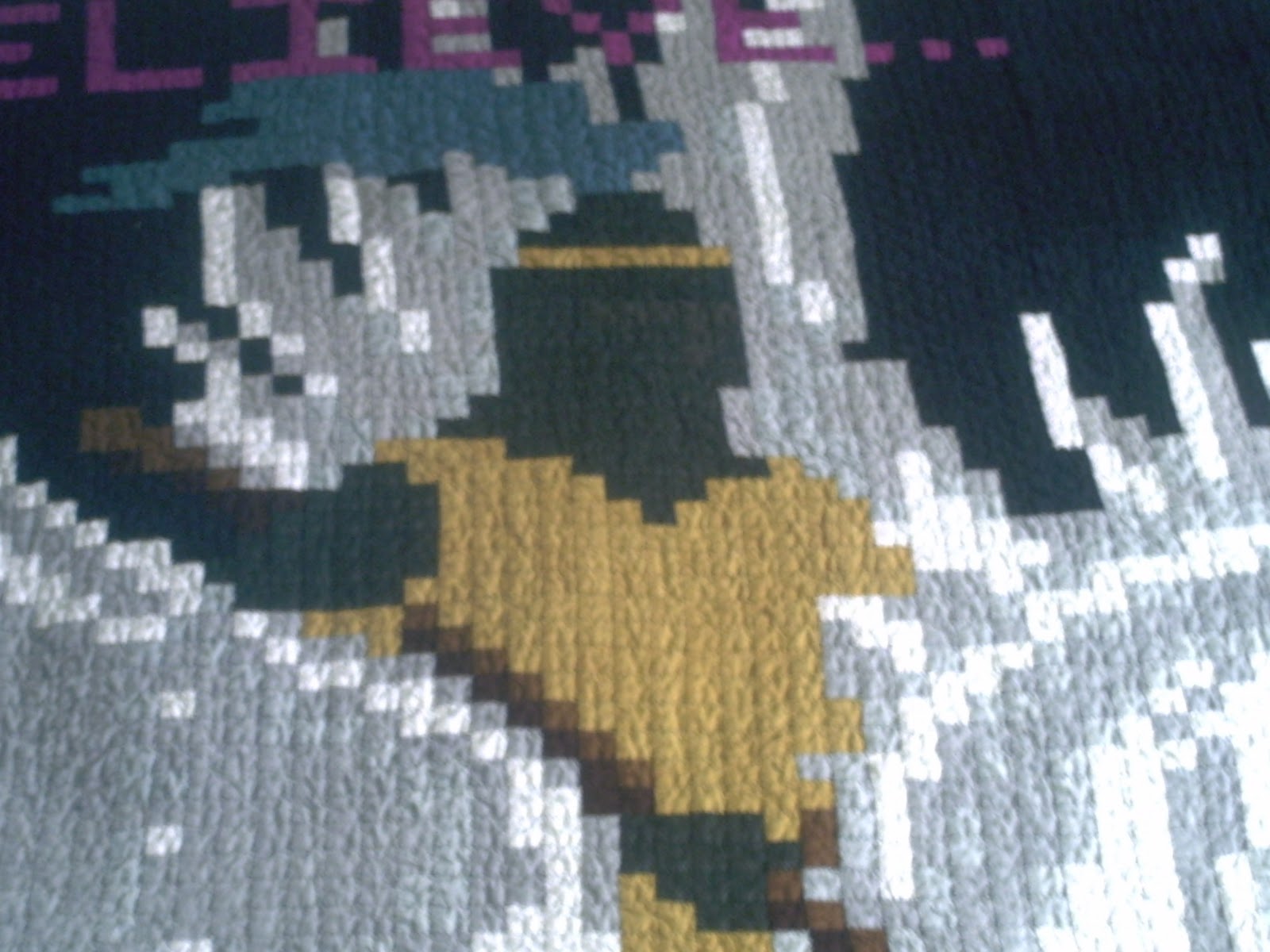
It started on a lark, the quilt I call Pegasus. My wife likes to cross-stitch and I like some of the patterns. I saw one of a knight riding a Pegasus and I liked the pattern. I'm a quilter. I like long projects. I'm also a novelist, and there are similarities between quilting and writing a novel. Both are big projects, and both require commitment.

A cross-stitch pattern, as you probably know, is made up of symbols on squares. Each symbol represents a color of floss (thick thread used in cross-stitch projects), and tells the person specifically which color floss to use.

Two pink squares, out of 7,544 total squares
I wanted to turn the pattern into a quilt. There aren't any directions for that sort of thing that I could find, so I had to wing it. I took the pattern to the local JoAnn's Fabric store along with a floss sample thingy (a highly technical term for a card that had little pieces of floss of every kind the manufacturer made) and went up and down the aisles of bolts of fabrics looking for shades and patterns for my quilt.
 The cross-stitch pattern had a lot of shades of gray, but I only used four or five in the quilt. After an hour or so in the fabric store, and having to use a shopping cart to carry all the bolts of cloth, I made my way to the cutting table. I'm used to getting strange looks in fabric stores, as I've explained elsewhere on this blog. They looked at me like I was nuts when I asked them to cut different sizes from each fabric. I don't think I told them what I was planning. Keeping them guessing was half the fun, and I didn't want to prove I was nuts by explaining my plan.
     The next step was cutting the fabric into squares 1.5" on a side. I needed the extra quarter inch around each square for seam allowances--that bit of fabric on either side of the seam (explaining for those who don't sew.) I used a rotary cutter, which is a device that looks like a pizza cutter but with a razor sharp blade that will cut through several layers of fabric at once. I cut thousands of squares, and held them together in little piles by running a strand of thread through the stack of squares, like stringing popcorn.
     I made a grid of 10 squares by 10 squares on a piece of paper and made a hundred photo copies. Using the pattern and having translated the symbols for floss colors to my own shorthand, I made my own pattern.
     It was finally time to start sewing the squares. I took my 10x10 square paper pattern and sewed squares to match. My big project became a series, a long series, of one hundred square blocks. Many of those blocks were 100 black squares, or black squares with a few gray squares, or...well, you get the idea. 
Variations of light make the quilt pop.
     When I finished enough 100 square blocks to make a row of the quilt top, I stitched the blocks together to make a row.
     You might be wondering by now how long the quilt took me to make. Three years is the answer. It was a pleasure watching the squares grow into rows and the rows start (slowly!) to reveal the larger pattern. I had started at the bottom, so over time I was able to see the long stretches of black squares become black squares with legs, then a massive white-gray-white-gray body, then the head build. I looked forward to the gold of the rider's armor. The quilt top became my quiet obsession.
The fabric in the armor looks like chain mail.
     Finally the top was done! I went back to JoAnn's and bought a dark batt--the innards of the quilt. Most quilt batts are white, but I was using dark fabrics, and didn't want the white of the quilt batt to shine through the dark fabrics. I couldn't find black fabric wide enough to make the quilt back from one piece, so I bought a couple of yards of magenta fabric and made a wide stripe of magenta down the middle of the black back.
   Then...how to quilt it? Quilting is what makes a quilt a quilt. It's the stitching, sometimes decorative, that holds the three layers together.
     I didn't want the quilting to be obvious. After all that work, I wanted the overall design to be the highlight of the project. I used black thread and stitched inside the seams on every square that made up the Pegasus's body, the wings, the knight, the lance, the head, etc. I quilted black X's across the black squares.
I'm pretty sure this quilt is a one of a kind. That's one of the many things I like about it. It's warm too, as you might guess. We use it sometimes.

Friday, January 13, 2012

Thank you Reader, for making my day! (It was better than giving my first autograph.)

I dreamed about having books out there in the wide-world for people to buy and read a long time before I published Sexton a couple of years ago. In one of those many, many daydreams (okay, more than one, but who's counting?), I wondered how it would feel to hear someone talk about my books when they didn't know I was listening.

Yesterday I found out. It was great!

I loaned a copy of Sexton to a friend of mine at work, and she put it on a table on the other side of the room. The table she put the book on is next to another room, a room I couldn't see in from where I was standing.

A female voice I didn't recognize came from the other room. She said, "Are you reading Sexton?"
My friend looked at me, then back into the room at the person I couldn't see. "Have you heard of it?"
"Yes. I've read all of them!"

My eyebrows shot up. I'll confess I got a little suspicious. I thought I knew all of the people at work who have read my books, but I didn't know the person in the room. I was sure of it. I'm good at recognizing voices, and hers was new to me.

"All of them?" my friend asked.
"It's a series."
"Oh! I didn't know that. They're sci-fi, right?"
"Fantasy. ...Good adventure, and they're funny too."

I walked toward the room. I wanted to see who my unknown fan was. My friend introduced us, and I was delighted. If you're an author and this hasn't happened to you yet, I hope it happens soon. It's terrific to hear someone talk about your work, and then getting to meet them. I suppose it's a different kind of terrific if they hate your work and bash it when you're in earshot, but even that ain't all bad. You might learn something you wouldn't learn otherwise.

Still, I'm glad she likes Sexton Chronicles.

Friday, January 6, 2012

A Lone Man at a Quilt Shop...Spooks the Natives

I walked into a fabric store this afternoon. I was by myself. The place was quiet when I walked in, and suddenly got quieter when the owner and three older ladies spied a man by himself in the doorway.

Usually, when a man darkens the doorway of a fabric store, he's being towed by his wife. He is expected to stand around with his hands in his pockets, inspecting the top of his shoes, and replaying a Lakers game in his head while he prays for the ceiling to collapse around him so he'll have an excuse to go out to the car and stick his head in the glove compartment. The natives of a quilt store expect this behavior of a man in their natural habitat and, although they might feel his pain, they also feel it makes up for the looks they get when they have to sit around a car dealership waiting to have their oil changed.

Not me. I'm quite comfortable in fabric stores. I go in alone to freak out the natives.

They eyeball you, those denizens of Ye Olde Quilt Shoppe. They eyeball the man the way one might eyeball a confused pink elephant that wanders into one's living room.

I wandered up and down the aisles of fabric on the bolt, pulling one or two and comparing them to each other in the natural light from the windows. One of the ladies came up and asked if she could help me. I smiled and said, "No thanks." I heard her whisper to the two ladies at the cutting counter when she walked away.

I pulled a couple of bolts from the shelf and held them under one arm. Walked to a different aisle to look at the brown fabrics. Looked at the ends of the bolts to see fabric content--which was a bit of a show, really. I can feel fabric content with my fingertips. Amateurs read labels to see if there's polyester in the fabric.

I took my sweet time choosing the fabrics I want to work with. It's a bit of a different color scheme I'm working on. I'm making this quilt as a gift for a friend of mine who just became a Dad. He has a little girl, and they decorated the baby's room in a combination of pink, brown, and white. The room is beautiful, and the colors play well together. I was enjoying putting fabrics together in that color scheme...but it wasn't easy. There aren't a lot of pink and brown prints out there.

By the time I wandered up to the cutting table, after taking my sweet time (all 8 minutes of it), the ladies stepped back except for the one who was going to cut the fabric. I have noticed over the years I've spent buying fabric that employees put men in fabric shops in two categories: a) lost, bored, pitiable husband, or b) crafting expert who knows-his-stuff-better-than-most or he wouldn't be there at all.

The polite smiles and offers of assistance changed when I put the bolts on the table and waited my turn. Tentative, almost timid questions and comments came:
"What are you making?"
"My...what wonderful colors those are together!"
"I wouldn't have thought to do that...but wow, that looks great!"
"How many quilts have you made?"

I'll confess I love those moments. I'll post photos when I'm done.

Sunday, January 1, 2012

Thoughts about this new year

Some people like to make new year's resolutions. I'm not one of them. Resolution is a strong word. It's something that someone resolves. I like goals. I've lived with goals most of my life, and I'm happy to say I've achieved many of them over the course of the years.

I haven't decided what my personal goals are for 2012, and I think that's okay. The year isn't very old yet. It's just begun. I can tell you my personal goals include finishing Sexton Retribution and publishing it. One goal is to write at least the first novel in a new series.

That new series will be about an American by the name of Nick Galizzi. If you've read Sexton Sand, you know who Nick is. He's an American, and he's a wizard. The new series will be fantasy, but it'll be set in this world. Nick can move around in time in ways most men can't, and I think he's going to have dealings with the most prolific serial killer in the history of this country, and evil man by the name of Herman Mudget who used the alias H. H. Holmes.

I also intend to do more to try to increase awareness of Wernicke-Korsakoff disease. The more I learn about it, the more I believe that recovery is possible. It's not easy to recover from that one, but it can be done. Read Green Goblin or Blackout: a Look Inside Wernickes (linked on this page) to find out more about that.

I'm sure other things to do and try will come up during this new year. I don't know what they are yet, of course, but I'm comfortable in my ability to face them without hiding under the bed too much.

Happy new year, my friends!

Friday, December 30, 2011

Answering questions the fun way...

Sometimes I get in an impish mood (okay--pretty much most of the time).

It's fun to answer someone's question, and only the question they ask--not the one they meant to ask.

For example:
When someone I don't know calls me on the phone and says, "Is Dave there?"
I say, "Yes."
Then I hang up the phone.

Tonight someone said, "Could you give these people directions to the hotel?"
I said, "Sure! I could..."

The other day a lady asked me: "Do you know where the bathrooms are?'
"Yes, ma'am. I do."

I'm small, but I know when to run!

Monday, December 26, 2011

Quilt Completed! We'll enjoy it for years.

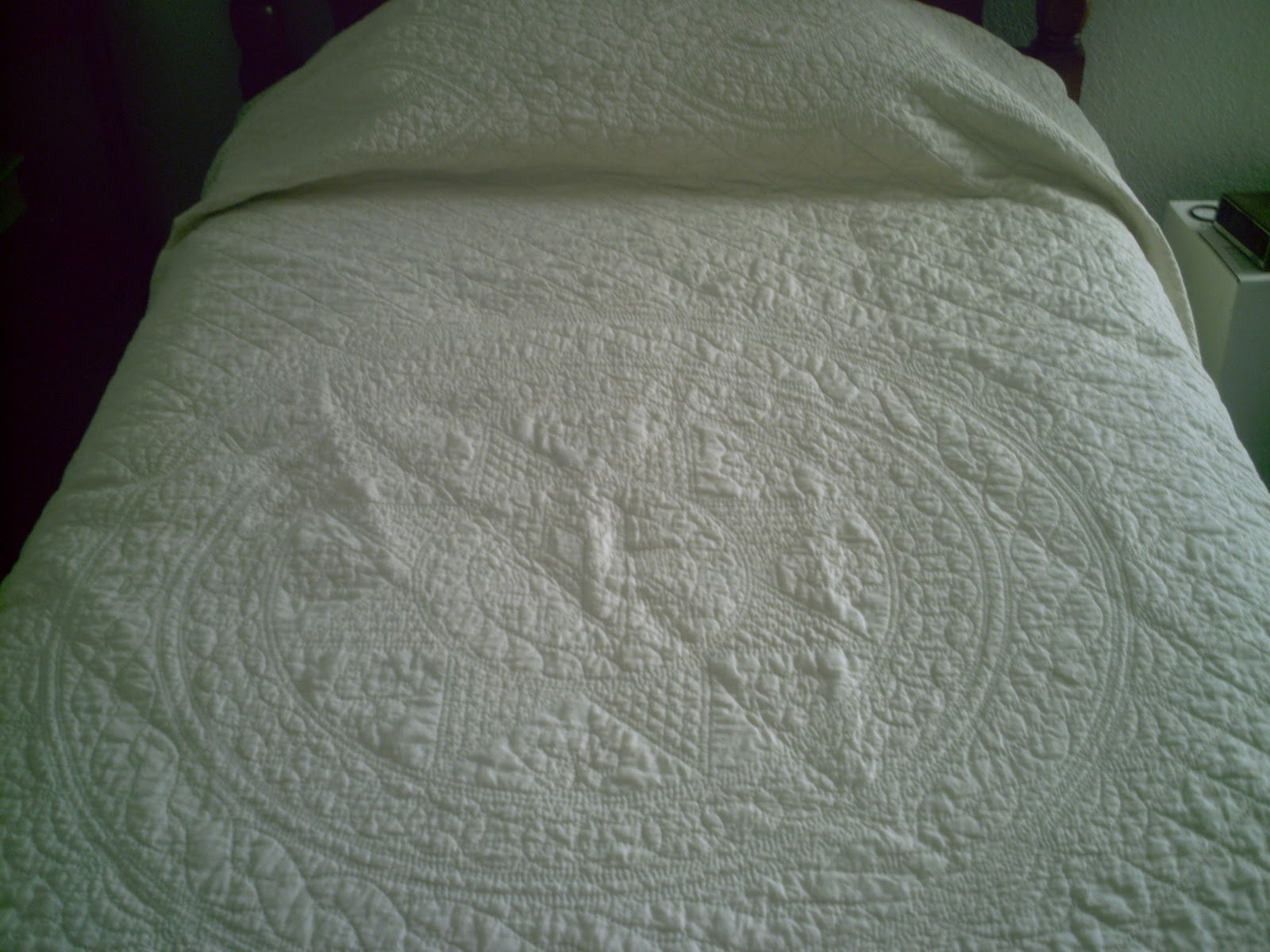
 I thought I'd share a few photos of the quilt I made my wife for Christmas. The quilt is actually for a queen size bed, but I put it on the twin bed in our guest room because the lighting was better for photos. Trust me...this bad boy will be on our bed for years. Under it will be other quilts I've made, but this one will be on top unless it's in the washing machine or dryer, or I feel like seeing some other quilt when I open my eyes in the morning.
I started making quilts years ago, after getting bored at my mother-in-law's house. My mother-in-law taught me some of the basics of quilting, and I put the lessons to use shortly after that.

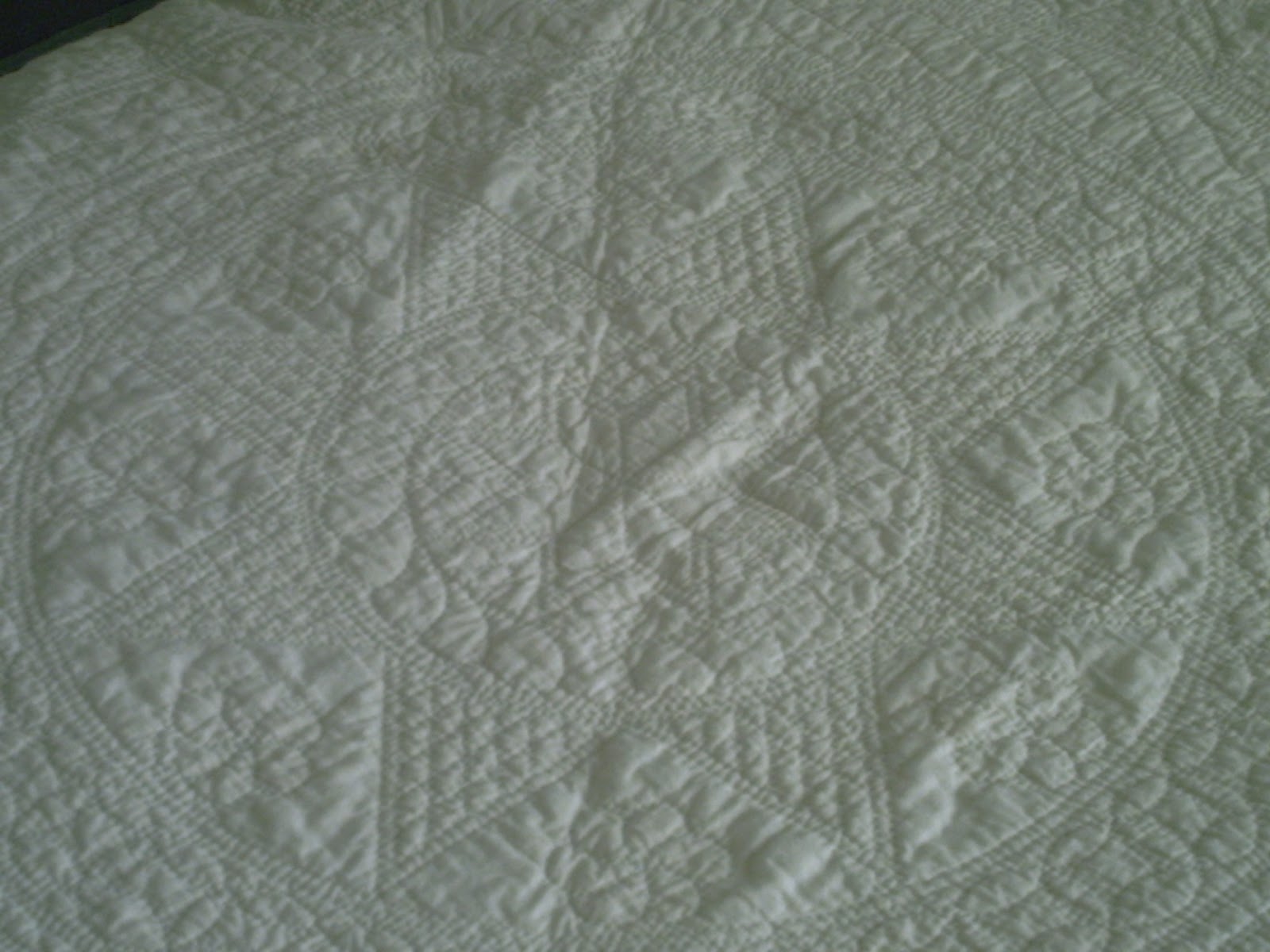
This quilt is made from one big hunk of fabric, and the lines you see are created by small stitches. A good quilter makes small, even stitches. I'm pleased to say I manage 7-8 stitches to the inch, and they're uniform in size. Most quilters will tell you that even stitches are the goal and that the number per inch doesn't matter much. I'd agree, but only in part. I like the way small stitches make the detail "pop."
Every line on this quilt is made by hand-stitching. My hands hurt a bit from all the stitching. A month and a half ago I got the idea that I would finish this quilt in time for Christmas. I did, but it involved a Herculean effort of 4-6 hours a day of stitching by hand. I used sports cream when my hands got sore, and it'll be a while before I can shake hands without pain.
It was worth the effort when she opened it and we put it on our bed.
Here's the story behind the quilt: 
When I took a job in Cleveland in 2003, my wife stayed behind in Wisconsin to finish out the school year. She's a teacher and we always said that if we moved during a school year, she would stay behind to finish it. I admire that, and that's what we did when I moved to Cleveland.  I lived alone in a one-bedroom apartment for a couple of months, and I got bored. I ordered a kit that included a top with blue lines (they washed out) and was intimidated when I saw how many blue lines I would have to quilt over to make this thing. I started it, got the center medallion done, and shoved it in a closed after my wife joined me.

I got sick in 2005, and if you've read much in this blog, you already know I was sick with Wernicke Encephalopathy. I recovered, which is a story of it's own. I used to drink while I was quilting, and I wasn't sure I would ever be able to quilt again. I was afraid I'd want to drink when I quilted. I was afraid I wouldn't be able to quilt as well sober as I did when I was drinking. Seriously! I have hand tremors. Drinking steadied my hands until sobriety slipped into drunkenness. 
When I was trying to decide what to give my wife for Christmas this year, I pulled the quilt out of the closet, looked at it and thought, "I have the middle done. Won't take much time to do that last four feet around." 
I should've known better. This isn't my first quilt. It's my fifteenth or sixteenth quilt. The center of the quilt is the easiest part--the smallest hunk. Each time around the center gets exponentially bigger, as anyone better than me at geometry can tell you. That's just about anyone, by the way. I'm a mathemagical moron.

Dogged determination is how one makes a big quilt when the only design is created by stitching. Quilting, (to steal a phrase and warp it a bit) is 10% skill and 90% persistence. I think I almost made up for the years it sat in a closet by finishing this thing in 6 weeks.

Sunday, December 18, 2011

A serious car accident, and we were able to help along with a lot of good people

It's a dark night tonight with no moon, icy roads, and a thin sheen of snow on the roads her in Michigan.

My wife and I were on our way home, driving North on I-75 through Flint, MI. I was at the wheel, and the road conditions had me driving well under the speed limit. My wife was sleeping in the passenger seat.

There are four lanes of traffic on that part of I-75. There was an accident. I saw two cars on the right side of the road, one on the shoulder, and pulled over to the far left lane. I was looking at the wreckage to see if others had stopped and if anyone was calling for assistance. There were other cars stopped, so I decided to keep moving rather than risk blocking traffic. I think I was moving at about 20 mph at that point.

On my right another car barreled by. I don't know how fast that driver was going. I can tell you she didn't hit the brakes.

She rammed one of the cars on the right, about twenty feet in front of our car. Sparks flew. It was horrific. I parked our car, no longer questioning whether or not we should stop. My wife woke up and I said, "There's been a bad accident and we're stopping to help." She agreed immediately.

I got out of the car and started walking toward the vehicle that was hit. It was now on my left, on its wheels, but sideways across the lanes. As I approached it, I saw a man bent over something in the road.

The something wasn't a thing at all, it was a someone. His girlfriend, as it turned out. She was lying facedown on the pavement.

I had a sinking feeling that she was dead. How could she not be?

She's not dead. I thought traffic was still coming at us, so I looked at the other man and said, "Let's get her out of the road before someone hits her."

We touched her and a woman behind me said, "Do not move her!" I didn't argue with her. I looked at the oncoming traffic and saw that my wife and another man--bravely--had stopped all other traffic. Several others were already on cell phones, speaking to 911 operators.

My wife (who has better and more up-to-date first aid training than I do) was at the woman's side, on the ground in the middle of I-75, along with several others. I went to the car that had been hit and flung, and looked inside to see if there were any other victims. The car was empty.

Then I went to the car that hit that one. The driver was a young woman, maybe 20-25 years old. She was shaken. A man had just finished speaking to her and he passed by me and said, "She thinks she killed that lady in the road. I told her she didn't."

The driver of that car, that young woman, was hysterical. I got her to calm down enough to be able to tell me if she was okay or not. She got the message that she hadn't killed anyone, and wanted to know about damage to her car. I don't blame her much for that. She was desperately trying to wrap her brain around something, anything, and she settled on asking about her car.

I took a look at the hood and said, "Your car is totaled, but I want you to look out the windshield at the woman on the ground. She's not dead, but she's not okay. Your car? It's the least of your worries. Are you okay? Are you hurt?"

"I'm okay."
"She's not dead. Breathe. Stay here. Don't get out of the car until EMT's check you out. Got it?"
She did.

Fortunately (and by that I mean the Hand of God was all over the place and quite present tonight), the accidents happened not far from a Michigan State Police post. Within just a few minutes, ambulances and police were on their way.

According to the boyfriend of the woman in the road, they were involved in an accident, and he got out of the car to check on the other driver. His girlfriend was driving their car, and she was about to get out and offer assistance as well. She unfastened her seatbelt...his door, the passenger door was open...

I went back to the woman in the road, and a man was saying a prayer of thanks over her, and I thought that was appropriate and a good thing to do. He said he's a doctor, and that she's lucky. He couldn't check her out thoroughly, but said her arm was broken and her shoulder was dislocated, but she wasn't paralyzed. I knew she wasn't paralyzed because I put a blanket over her feet (her shoes flew off when she was thrown from the car), and she moved her legs when I did that. Others had already covered her with coats and blankets from their cars.

It was about an hour between when we came upon the accident and when we were turned around and allowed to proceed, slowly, home.

I'll probably never know the names of anyone involved in that terrible thing, but I know this: there are a lot of good people on this beautiful world of ours. We all make mistakes and accidents happen, but it helps a little to know that there are a lot of good people who will do a lot, risk a lot, to help their fellow human beings when they're in trouble.

Merry Christmas! Drive safely.

Sunday, December 4, 2011

I'm making something that could last 100 years. What's a Quilt?

A quilt is a quilt. A blanket isn't a quilt unless it's quilted. A comforter isn't a quilt. A knitted or crocheted blanket isn't a quilt. Only a quilt is a quilt.

What makes a quilt a quilt? Trust me--you want to know this unless you want to offend someone who has a bevy of little needles and isn't afraid to stick them into soft parts that bleed. They stick their own fingers frequently, so don't assume they won't stick you if you offend their over-declicate though deservedly delicate sensibilities.

A quilt is three layers, sewn together. A quilt consists of a top, batting, and back, stitched together.

If it's knit, it's not a quilt. It's a blanket, it's an afghan, but it's not a quilt. If the top and back are tied together with bits of yarn...it's not a quilt. It's a comforter.

I'm making a quilt for my wife for Christmas. It's a beautiful thing already, and I'm only in the quilting stage. It's not my first quilt. I think it's my fourteenth or fifteenth. I've been a quilter for almost twenty years now, and I'll admit I'm pretty good. Okay, false modesty aside, I'm very good.

Quilts tend to last a very long time because people treasure them. They should treasure them. I make mine by hand. Every bit by hand. Takes a long time to stitch the design through all three layers, and the stitching comes at a price. Hand damage is one price, if I quilt too long. You can see burst blood vessels on the back of my needling hand, and callouses develop on the tips of my fingers. I use the nerves in my fingers to tell whether my stitches have gone all the way through, which means I don't use a thimble. Wakes me up a bit when I stick myself, but it's worth it.

The quilt I'm making my wife for Christmas it a white on white quilt. The top and back are each made from one very large piece of cloth (nearly 10 feet by 10 feet), and the stitching--called quilting--makes the design. It can be washed in the washing machine and dried in the dryer and will be stronger for it, for the first forty or fifty years or so. That's part of what makes quilts durable.

Like vampires, quilts don't hold up well to sunshine. This quilt is white, so sunlight won't fade the colors. It's still going to be vulnerable to sunlight because direct sunlight dries the cotton and that makes the fibers weak. If you have a quilt, please don't let sunlight fall on it on a regular basis. Eventually it will fade and fall apart. If you have to let sunlight fall on it, rotate it from time to time and keep the fading--which gives it an antique look--as uniform as you can throughout. Take it off the bed every once in a while and use something else as a bedspread.

If you're lucky enough to have someone make you a quilt, please don't ask them to make it large enough to cover your pillows and go all the way to the floor all the way around. I've stopped making quilts for most people because of requests like that. If you want a bedspread that covers the entire bed, frame, and pillows, get thee to a Walmart and buy a bedspread. Adding a foot or two on all sides increases the area of the quilt by a lot (simple mathematics), and offends the quilter. Quilters, by the way, who are people who make projects intended to span generations, have long memories.

Darn. Can't get started yet. I'm waiting for the recipient of the quilt I'm working on to go to bed. This huge white on white quilt, the one that takes me four hours to quilt a single square foot, is a surprise Christmas gift for my wife. I'm on a deadline. Soon I will start humming a lullaby...and I hope it puts her to sleep, and not me.

Monday, November 28, 2011

No Credit Card? You can shop online without one!

My wife and I try not to use credit cards unless there's an emergency. Some people don't have a credit card. How do you take advantage of Cyber Monday deals when you don't have a credit card, or don't want to use a credit card?

It's easier than you might think.

Banks and credit unions sell Visa gift cards. The idea is that one can buy a Visa gift card and give it to someone instead of cash. I don't look at those as gift cards.

I see them as prepaid credit cards. In fact, they offer a better deal than a credit card. Visa gift cards only cost a couple of bucks to buy, and you can deduct the cost of the card from the value of the card.

When you want to make an online purchase, you enter the numbers from the gift card and make your purchase. Online retailers accept the gift card as if it was a credit card.

Head to the bank and get a Visa gift card, then head to your internet connection and take advantage of those great deals from internet shopping sites. While you're at it, let me suggest one--one where you can buy a set of great books by  a guy named David J. Steele (me!):

www.lulu.com/spotlight/Misticuf

Wednesday, November 23, 2011

Sobriety, the Holidays, and Me

There's nothing wrong with having some drinks during the holidays. For many, it's part of the holiday tradition.

I'm a survivor of Wernicke encephalopathy, which means I can't drink. I used to drink a lot, by any standard. Drinking almost killed me, and I've written quite a bit about that.

I'm sure it's hard for some alcoholics to stay sober during the holidays. I'm lucky. It's easy for me to stay sober during the holidays, and I'm grateful for that blessing. I don't feel jealous, and I don't get worried about those with glasses of adult beverage in their hands. I get a kick out of it actually, and find myself glad I don't want any of what they're having. I sip my decaf and smile.

I remember hearing the whispers no one thought I could hear the morning after. The whispers of concern, quiet concern, about the quantity I consumed the night before. I remember feeling bad about things I might have done or said, but that were gray memories the morning after the holiday. I don't miss the wondering, or the whispers.

Is it hard for me to stay sober during the holidays? Nope. I add sobriety to the long list of things I have to be thankful for.

Happy Thanksgiving. Merry Christmas.

Friday, November 18, 2011

A Quilt for My Bride

We've been married almost twenty years, and my wife is still my bride. I don't have to close my eyes to see her in that white dress.

This Christmas she's getting a quilt. Another quilt. A special quilt. It'll be special to her, anyway. It will be special because I'm making it. It will be special to her because, like her wedding dress it's white. White fabric, white stitching. A lot, I mean a boatload of white stitching. It's whole cloth quilt. Whole cloth quilts are quilts made from one piece of cloth. In this case, the piece of cloth is 102" by 102".

There's a story behind this quilt. There's a story behind every quilt, which is part of what makes them special. Here's the story behind this quilt, this quilt for my wife:

In 2002, I moved to Cleveland to stay with the BSA when my position in Wisconsin was eliminated. I rented a one-bedroom furnished apartment, and she stayed behind to sell the house and finish the school year. She's a teacher and we agreed she would never move during the school year.

I was lonely and started making a quilt. It's my fifteenth quilt. It's not hard to make a quilt. You only need to know how to do a running stitch. Get good at it, is my advice. To make a quilt, you're going to do a lot of running stitches, mostly tiny ones. Thousands of thousands of tiny stitches. That's what makes it a quilt. Tiny stitches through three layers: top, batt, and back.

I started the quilt in that apartment. Worked on it day and night. When she moved to Cleveland and we bought a house, I put it away in a closet. Never forgot about it, but didn't do any more work on it. When I got sick with Wernicke Encephalopathy, I stopped quilting. She has asked me several times why I stopped quilting, and I didn't have a good answer. I think part of the reason I stopped was that I always drank when I quilted, and without drinking I wasn't sure I could quilt anymore.

That was a foolish notion. I can't think of anything I can't do better sober than I could when I was drinking. The test came about three weeks ago when I decided to finish that quilt and give it to her for Christmas.

Honestly, I can't see any difference in what I'm quilting sober and what I quilted with a few beers under my belt. That's a good thing. It answered my fear that my hands wouldn't be good anymore. I have essential tremor--a medical condition that makes my hands shake--and beer helped me steady my hands enough to thread the needle. Now sheer stubbornness helps me thread the needle. I just keep poking it until I find the eye.

In any case, this quilt is going to be a beautiful addition to our bedroom. I have miles to go before I finish it. I've been quilting for at least four hours a day for the past two weeks, and have to keep up that pace until Christmas if I'm going to finish it. I'll tell you this... I'm going to finish it. That's how I work.

Monday, October 31, 2011

Anosmia means I can't smell...

Anosmia. As disabilities go, it's not bad. We (speaking as a human) typically have five senses: sight, hearing, touch, taste, and smell. I didn't put the words in any particular order, but those missing the first three have bigger problems than those lacking the fourth and fifth. I feel for the blind, and deaf, and those who can't feel physical sensation. Those who can't taste food have problems, too. I can't imagine what that's like.

In all likelihood, my sense of smell went out the window with the first touch of wernicke's. I didn't notice it go. Shoot... I didn't really notice it was gone until 2005, but I'm sure it went away before that.

I was able to smell when I was younger. Some people are born without a sense of smell, but I'm not one.

There are dangers in not being able to smell. Not as many dangers are there are to those who can't see or hear, but there are dangers. I just have to be careful.

What are the dangers? Thanks for asking (or reading).

I once cleaned my coffee maker with ammonia instead of white vinegar. We used to keep the jugs of both chemicals under our kitchen sink. Not anymore. I couldn't smell the difference between vinegar and ammonia. Fortunately for me, I hate the taste of vinegar. When I clean the coffee pot, I rinse it five or six times. I didn't drink the ammonia, but my wife knew something bad had happened the second she walked in the door.

I make doubly sure to change the batteries in our smoke alarms. If there's a fire and I'm the only one home, I won't wake up with the smell of smoke. I get a little worried when I clean behind our gas stove. If that pipe goes, I won't smell the telltale odor of gas.

If food in the fridge hits the dubious line between fresh and puke-your-guts-out, I have to ask my wife (she smells great!) to tell me which side of the line it's on. I mean, sure, sometimes I can see when I should toss it. Gray ham is never as good as it sounds...

Sometimes I can smell. The sensation confuses me. It tends not to last long. Goes away in a few minutes. When the sense does come and I figure out what it is I'm smelling, I have noticed that most of the time (darn luck) I'm around something that doesn't smell good.

In my case, there isn't much hope the sense will come back on a permanent basis. Nerve damage is the cause. I'm okay with that. I'm a survivor of Wernicke-Korsakoff. Losing my sense of smell was and is a small price to pay.

I did a little research tonight to see if anosmia is effecting my sense of taste. Some say it does, and they're probably right. I can taste food. I don't get the aroma that makes some food taste better. I don't get hungry for bread when I pull it out of the oven, but I do like the way it tastes.

I'll never be a good judge of fine wines, I say with a laugh, and that's okay! As a survivor of Wernickes, I can't drink that stuff anyway. Grape juice (the closest I come to wine) tastes like grapes whether I can smell it or not.

Friday, October 28, 2011

Don't fear the semicolon; love the semicolon

I think I gave more than one junior high teacher and at least one high school teacher a rash by asking about the semicolon. You know the semicolon: it's a period on top of a comma.

;
The semicolon seems to be a feared bit of punctuation. Most don't know how to use it, and if they do know how to use it, they're afraid of it. It's not a colon. A colon is a big deal. It adds emphasis, and it announces lists. The colon can make the leap from sentence to mathematics, where it announces a ratio.

But how do we use it in language? How do we use it in writing?
Don't feel bad if you don't know how to use a semicolon. And no, grammarian wannabe, I don't mean badly, I mean bad. As in "bad person." You're not a bad person if you don't know how to use a semicolon. 

Think of the semicolon this way--the way that finally worked for me: it's a hinge. A semicolon is like a hinge in that it can join two sentences very closely together, as a hinge on a door joins the door to the frame.

A semicolon is a marriage between the period and the comma. It's a partial stop. The acid test for the semicolon is whether or not the two parts of the joined idea can stand on their own. Take a look at this example:

1. I like semicolons. They're cool.

Two separate ideas. The way the example is written, we read two things. Two separate things, joined only by proximity.
But...if we want to speed it up and express the point in a subtle way, example two comes in:

2. I like semicolons; they're cool.

If I wanted to make a bigger deal of it, I would whip out the colon:

3. I like semicolons: they're cool.

There is a certain dubiousness to the semcolon, cast upon it by English teachers--the dusty ones who don't want to argue punctuation as style. Don't get mad at them for it. They're mostly human and have limited time to spend on the more subtle pieces of punctuation because they're too busy fighting the run-on sentence to give students the out by teaching that a semicolon exists, yes, exists, to make the run-on sentence a piece of good writing.

*I salute E.B White who, in addition to his famous book Charlotte's Web, wrote Elements of Style, a little grammar book that explains things like how to use a semicolon. Some people harried good old E.B for writing the book. Those people were pretty successful in burying the little book. Those people were grammarians who want to apply rules to communication by regulating punctuation and other rule-ish stuff like that. Those people, in their anal retentiveness, obviously couldn't read the title and didn't know the difference between grammar and style.

Sunday, October 16, 2011

Wrting--when it's gooooooood

I wish I could see a brain scan of what happens with my gray matter when I'm writing and I'm in the zone.

I was in the zone earlier this evening, working on Sexton Retribution. It felt great. What's it like to be in The Zone? I'll try to explain...

Stephen King called it "The Hole in the Paper", that special feeling a writer gets when he or she is able to write as thoughts occur, when fingers fly and words seem to appear of their own volition. I call it The Zone because it feels like a place.

If you've seen that TV show with the woman who works with the police and has a perfect memory, you'll know what I'm talking about. When she goes into her memory to revisit a crime scene, the viewer sees her in the middle of the scene observing everything around her. In those scenes, she's in what I'm calling The Zone.

Tonight I started a chapter with a frightened Cedric alone in his room in the Fortress Balfour. I could see him on the bed, struggling to stay awake, knowing he was about to be visited by what he thought was a ghost. That's the image I had in mind when I started to write. While I let my fingers go on auto pilot, I imagined (saw) pertinent things in the room: candles on the table by the bed, more candles on the table by the door. On closer examination, I saw he had blocked the door with a dresser and a chair.

I didn't have to think about him blocking the door, I didn't have to think about what he would block the door with. Those details were part of the picture in my mind. When Nick's form appeared in the room, I "saw" Cedric react. Writing about it was secondary. I didn't have to compose the sentences. They just came to me. The dialog came to me too. I was playing the scene in my head.

When I'm in The Zone, I don't feel like I'm directing a movie. I'm not conscious of composing sentences. I don't feel like I'm the one writing the dialog. My hands are divorced from my consciousness. They caress the keyboard.

That's why I write... I love the zone. I love to read the output, but mostly I love to be in the scene, unconsciously recording the conjurations of my mind.

Wednesday, October 12, 2011

Boy Scout training has helped me save a life or two...

I earned my Eagle Scout a few weeks before my 14th birthday, and stayed with the program through college, and spent 17 years as a professional Scouter. I've had the opportunity--by being in the right place at the right time--to save a couple of lives, but not because of anything special about me. I know how to react in a crisis, and I think most of that ability came from the years I spent as a kid in the BSA.

The first time I saved a life, I had to put my own at risk. We were in Peru, and a man did a foolish thing. He tried to cross a rope bridge over a river running through a narrow canyon in the Andes mountains. He fell. I jumped in after him. The water was glacier run-off, very fast, and it tossed us both against a rock like we weighed nothing. It wasn't a pretty rescue. We both made it out more by the grace of God than by any sort of swimming ability. I know two things about that: 1) I was able to stay calm because I was trained to stay calm, 2) I was also trained that doing something is better than doing nothing.

The second time I saved a life was at no danger to myself. My neighbor across the street was screaming at the top of her lungs. I couldn't see her swimming pool from the window of a bedroom on the second floor of my house, but I could see her over her privacy fence, staring down at the pool at something and screaming her head off.

When someone is standing by a pool, screaming their head off...odds are pretty good there is something in the pool that has struck sheer terror in their heart. There was. Her grand-daughter, a toddler, was in the pool unconscious. I ran across the street, ripped open the gate, and jumped in the pool after the girl. I pulled her out. She was unconscious and not breathing. She started breathing with God's help before I could remember how to do infant mouth-to-mouth.

Last night while at work, I heard someone fall down some stairs near where I was standing. I ran down the stairs and found an older woman lying on her back on the stairs. She was trying to pull herself up. I held her gently by the shoulders and saw blood on her forehead. She must have spun to her right and struck either the banister or the wall on her way down. I held her and told her not to move while I felt (gingerly) the back of her neck to see if there were loose bones. She was able to move her arms and legs. I told her to stay put until help came. Another man came down the stairs and took my position while I used the telephone nearby to summon help. I didn't notice the blood on my hands until after I called 911. I'm kicking myself a little bit for that--the blood came from a wound on the back of her head from striking the brick at the bottom of the stairs.

She was alert and conscious when the paramedics took her to the ambulance. I hope she's okay now.

I'm nothing special in this regard--I'm just trained to react. I think that's one of the many things the BSA means with the motto of "Be Prepared."

Thursday, October 6, 2011

Sometimes I love the old ways, like shaving soap & mug

Shaving cream is alright. It's a time saver. Just a shot of the stuff in the hand, smear it on the face, and you're ready to shave. I use it sometimes and get satisfactory, but not great results.

Like shaving cream, the new ways of doing things have their advantages, and most of the time the advantages are enough to win popular support and all but kill off the old ways.

This morning, and yesterday, and tomorrow, I shaved the old fashioned way.

You can still buy shaving soap in most places. It comes in a little box, about half an inch high, by three inches, by three inches. In the box is a little round cake of soap. I have a cake of that soap in a mug on the shelf in the bathroom and a shaving brush--an old one from my grandfather--with long, soft bristles. I get the brush wet and swish it around in the mug. I like the clink, clink, clink of the handle of the brush hitting the sides of the mug. I like the feel of the soft bristles as I paint my face with the thin layer of foamy, warm soap. I use a moden twin-blade razor. The razor does a good job, and the thin layer of soap is just enough to lubricate the bristles, but not so much that it clogs the razor.

When I'm done, I have a soft, smooth face. Sure, sometimes I still use the shaving cream. Sometimes I just don't feel like I have the three minutes or less that it takes me to make the lather in the mug. When I'm really feeling pressed for time, I use an electric razor. It's not the same, though. I can feel the difference all day and feel like I cheated myself out of a simple pleasure (and better shave.)

My fountain pen is another example of a thing of the past (mostly) that has been replaced by an inferior, but more convenient device. The ballpoint pen has trumped the fountain pen. It's cheaper, even if you buy a nice one that requires refills. The ballpoint pen doesn't spatter ink of you drop it. You're not going to bend it out of usefulness if you drop it. It can write on almost any surface.

It also smears ink on my left hand when I write, unless I handicap myself by bending my wrist unnaturally and obscure my already bad handwriting. No thanks.

I like the pleasure--yes, I said pleasure--of writing with a fountain pen. You can really feel the contact with the paper through the sound of the nib (the point, for the uninitiated) on the paper. The ink flows from the nib and sinks into the paper. There is no smear on my left hand.

For a couple of years now, I've been using my Cross fountain pen. I bought it with my first royalties check for about $60, and I don't let anyone else use it. It's my pen.

At first I bought modern ink cartridges that fit in the pen. No muss, no fuss with those ink cartridges. They're a modern contrivance for an ancient device. Yes, ancient. The first fountain pens appeared in Persia before the death of Christ. I discovered those little ink cartridges get expensive. I was going through about three a week.

So I went back to the old way. I fill my fountain pen from a bottle of ink now. That takes a little practice. At first I got ink on my forefinger and thumb when I filled the reservoir from the bottle. Now I don't.

Shaving soap and mug. Fountain pen and bottle of ink. I love them. I'll tell you what else I miss, for what it's worth. I miss writing on a typewriter. I don't do that anymore.Writing on a computer is much better (for me at least) in every way than writing on a typewriter. But... I do miss the sound of the keys clacking on the paper on the roller. If I could find a program that made those sounds to go along with my word processor, I'd be happier when I wrote. That would take some doing--I'm happiest when I'm writing.

Tuesday, October 4, 2011

It was like watching a Benny Hill sketch, or someone try to herd cats...

I get a kick out of life.

Tonight was a slow night at work--where I greet people when they enter the building. It's a very large restaurant with several dining rooms, and guests need someone to make them feel welcome and tell them where things are.

A bus group came by for dinner, with 56 elderly passengers and one tour guide. After the meal, several of the passengers asked me where the gift shop was. I told them, of course. It's part of my job. They went downstairs to the shops in twos and threes. A couple wanted to know if they could get to the bus from the shops and I told them how...also part of my job.

Apparently (and this is the part I really like), they were told they didn't have time to visit any of the shops. As I stood at the top of the stairs, I saw the passengers going as many different directions as was humanly possible. The tour guide walked into the lobby, looking for her passengers.

Old doesn't mean dumb. Those passengers knew darn well the bus wasn't going to leave until they were all on it. The tour guide knew that they knew that. Her exasperation was obvious.

She went downstairs to round them up. I didn't laugh, but I could hear the music from The Benny Hill Show playing in my head as I watched pairs and singular elderly passengers hustle in different directions at the bottom of the stairs, while the tour guide ran back and forth trying to get them back to the bus.

It was like watching someone try to herd cats.

Friday, September 30, 2011

Taking my own advice: a writing exercise

I need to warm up a little before writing chapter four in Sexton Retribution. It's been a couple of days since I wrote the last chapter.
Let's see... Nah. Let's not see.

He got out of the car and frowned at the dark house. Tripped on the third step on his way to the porch. Drizzle, cold drizzle fogged his glasses and didn't help him see. He wished he left the light on, but it was still sunny when he went to work.
  Three jabs at the doorknob with his key finally resulted in success. He twisted the door open and walked onto the porch, reaching for the light switch with his left hand.
   Stepped on something soft, greeted by a his and a yowl that would've made a hellhound cringe. Both he, and the cat he just stepped on, cussed out loud.

Hmmm. Well... Now that I have bad writing out of my system (please, o' Ralph the Muse, let it be so), I think it's time to get serious and put good stuff in the next installment of the Sexton Chronicles. 


Wednesday, September 28, 2011

Where do I get my ideas? I'll tell you in a word.

...Everywhere.
Ideas are the easy part. We all have ideas. They might be ideas for a book, a commercial, a song, a painting, or a better way to slice cheese. Ideas are the easy part.
   Execution is the hard part.
   I've talked in past blog posts about a time in my recent past when I had lost the ability to write and how hard I worked to get it back. I won't bore you with that if you've already read it, and if you haven't, I invite you to poke around this blog a bit until you find it.
   Now I find I can execute the ideas--put them on the page in paragraphs and dialog, description and mood, reflection and protection--with ease, most of the time. When I have difficulty, I just start posting things on Facebook, or temper myself with the Tweet limit of 140 characters.
   Sometimes it comes easily and I give credit to a fictional character I created, an affectation I call Ralph, the Muse. Good old Ralph, though he doesn't exist, wears a long, stained, once-white toga like bed sheet, has tangles in his beard full of bread crumbs and lost forks, and smells pretty bad. Sometimes it comes like an eight-grader trying to write a 500 word report on Robert Frost's poem about taking one path or the other through the woods when it's plain he would rather be inside watching cartoons (Frost, and the eighth-grader.)
   Here's a tip for someone who wants or has to write, but can't get started:
Write something. Anything. Just get the juices flowing. Be prepared to delete or otherwise obliterate what you write. Or post a Facebook update about something ridiculous (especially if you need to keep your eye on word count), and then delete it or show some cajones and post it.
   I think you'll find that getting the motor started is the hard part, and that once your brain is used to stringing words together it's pretty easy to continue.
   Go for it. Stop reading now. Write something.

Monday, September 19, 2011

If you need a speaker who knows Wernickes from having it...

I'm willing to talk to people, or groups, about my experience with Wernickes and Korsakoffs. I'd like to bring hope to some folks, and maybe get a chance to thank health care workers.

I'm not looking to make money in speaker's fees, and would probably turn them down if offered. I'll gladly speak for free. The only problem I would have is that I don't have a travel budget. If you'd like me to speak to your group, please let me know. If you can get me there and provide a place to stay and meals (if needed), I'll come if I can. I'm not asking for anything in return, just a break-even deal for me. You can contact me via email: wernickesurvivor@gmail.com

I wrote a book (links are on this page) called Green Goblin, which is my narrative of the time I spent in the hospital with Wernicke Encephalopathy, and Blackout: A Look Inside Wernickes", which includes the full text of Green Goblin, and more on the healing/recovery process I went through.

I would like to see more done to prevent the disease, and more done to help sufferers get back on their feet.

Monday, September 12, 2011

Blackout: A Look Inside Wernickes -- A new book, by a survivor

http://www.lulu.com/product/paperback/blackout-a-look-inside-wernickes/16965121

This book was hard for me to write, but I felt it had to be done. I can't find any other survivor's accounts of Wernicke-Korsakoff. I wrote "Green Goblin" as a stand-alone book, describing what it felt like to be in the hospital with Wernickes, and touching a little on what came after.
This book contains the full text of Green Goblin, as well as the long journey I went through before being diagnosed with Korsakoffs. It is my hope that someone (or a lot of someones) will benefit from this book. Recovery is possible--not easy or common, but possible--from Wernickes. It is possible for someone with Korsakoffs to manage the illness and go back to normal life. I don't have answers as to how that can happen, but I can show that it did happen in my case.

The link takes you to the paperback version. It's also available as a hardcover, and soon will be a Nook book at Barnes and Noble, and a Kindle book at Amazon.

Thursday, September 8, 2011

What's the story--Sexton Chronicles? What's it about?

The Sexton Chronicles is a series of fantasy novels about Tom, John, and Andy, three American teenagers who find a gateway between worlds. They have to make their way in a world they don't understand, and do surprisingly well.

 In the first book in the series, they are separated. John and Andy make friends with a man they knew of but who vanished in Mexico in the early nineteen hundreds, a man by the name of Ambrose Bierce. Tom is trained in law enforcement, in a police force that kills criminals without the benefit of a trial.

Once re-united, the three young men discover a lucrative trade--buying forbidden herbs and spices from a country to the south of Sexton, and importing them for sale in the doughnut and fried chicken restaurant they open. Simultaneously, there is an evil power in Sexton re-awakening after long centuries of dormancy. The three Americans are once again caught in events beyond their control.

By the time the third book in the series begins, they feel responsible for the brewing war with the country to their south. Things are not going well for them.

In the fourth and recently released book, Sexton Sand, the Americans are on a mission to end the war and free their friend--a man from the enemy country, who also happens to be its king--from a demon possessing him, and stop the war they feel they started while they're at it.

I have begun the fifth and final book in the Sexton Chronicles series. It's called Sexton Retribution. The title will give you a clue.

The books are available in paperback and hardcover from www.lulu.com/spotlight/Misticuf or from amazon as a kindle books, or Barnes and Noble as Nook books.

Sexton Chronicles. School has started--don't you think you deserve a little adventure yourself?

Wednesday, September 7, 2011

"Blackout: A Look Inside Wernickes" --closing paragraphs

I finished the first draft a few minutes ago. The book I'm writing, Blackout: A Look Inside Wernickes", which will be available for purchase in a week or two, is ready for final edit and publication. The book contains the text of Green Goblin, as well as details of my struggle with Korsakoffs.

I thought I would share the closing paragraphs with you. The 'how it came to be' is what makes up the rest of the book, a short book of 140 pages.


§
Sobriety
I remember what the doctor I mentioned earlier in the book said about having one or two being okay. I’m not going to do it. In my case, it isn’t okay. I’ve “slipped” once or twice, but not often. The slips are followed by a period of self-anger I don’t like. I don’t do that anymore. On those couple of occasions when tested myself, and had a beer, I paid for it with bouts of dread and uneasiness in 24-48 hours. It’s not worth it.
I’ve had foods prepared with alcohol in the recipe: a beer dumped on hamburgers prior to grilling, in a rum cake, and maybe one or two recipes others prepared. Same deal as above: uneasiness, and random twinges of unidentified fear. Now I ask if there is alcohol in the preparation of food, and if there is, I have something else.
That doesn’t mean there aren’t times when I would love to sit down and drink a few beers. There are times when it sound great. Then I don’t do it. I just don’t. I have too much to lose, and I’m not going back to that dark place with the red hills. Sobriety is key. I still have no desire to attend AA meetings, though I know they help a lot of people. I do my best when I don’t think about drinking, and do other things with my time, like write, and cook, and bake, and read, and spend time with my wife, and, and, and...
I still enjoy situations where alcohol is present. I like bar environments, and restaurants, and parties. I actually like them better now that I’m sober. Some people who have had struggles with alcohol and alcoholism don’t or can’t be around those situations, and most people respect that. I think I’m lucky I can go anywhere and not drink. If it bothered me I would avoid those situations, and that’s probably not easy. In my present, paying job (other than writing books), I spend hours at a time less than ten feet away from the bar. Not only does it not bother me, I like it.
You see, my friend, every time I don’t drink...every day I’m sober, every night I fall asleep sober...I win. When I go to the grocery store or drug store, I go out of my way to walk past the beer, wine, and booze. If you’re next to me you might hear me hum and chant, “Nee-ner-nee-ner-NEE-NER!” I’m singing to the containers. I won.
I’m not going to play again, mind you, but I won.